
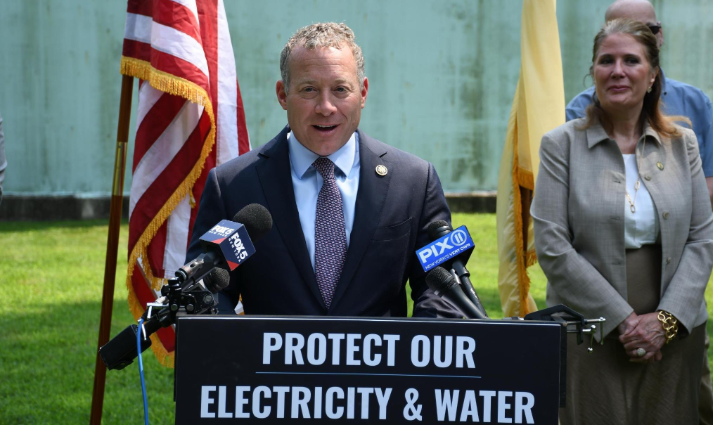
Gottheimer announces bipartisan cybersecurity plan after attacks on New Jersey water systems

PARK RIDGE BOROUGH, N.J. (Bergen County) — U.S. Rep. Josh Gottheimer has announced a package of bipartisan federal proposals aimed at protecting water, electric and other critical infrastructure from cyberattacks following recent attacks targeting municipal water systems in New Jersey and other states.
Gottheimer, D-N.J., announced his Critical Infrastructure Security Plan on Wednesday in Park Ridge. The plan includes two pieces of bipartisan legislation and a request for federal agencies to increase technical assistance and incident-response resources for water and wastewater utilities affected by cyberattacks.

“Every morning, folks in this town wake up, turn on the faucet, and clean water comes out. You flip a switch and your lights come on. Nobody thinks twice about it. Nobody should have to,” said Congressman Josh Gottheimer (NJ-5). “I’m standing here because in towns just like this one, all over the country, that deal we have with our utility companies has been put in real jeopardy, and if we don’t get out ahead of it, it could mean a disaster.”
According to Gottheimer’s office, hackers have targeted water systems in New Jersey and at least a dozen other states during the past two weeks.
Two municipal systems in Cape May County were among those targeted, according to Gottheimer’s office. Operators were forced to manually operate valves and pumps after losing access to digital controls.
The FBI is investigating incidents in at least seven states, while the Cybersecurity and Infrastructure Security Agency, Environmental Protection Agency and FBI have issued a joint advisory urging water systems to strengthen their cybersecurity protections, according to Gottheimer’s office.
Investigators have pointed to Iranian-affiliated actors while also examining whether other hackers are using similar tactics, his office said.
Gottheimer said smaller utilities can be particularly vulnerable because they often lack dedicated cybersecurity personnel and rely on older infrastructure.
There are about 150,000 public water systems nationwide, according to Gottheimer’s office, with 97% serving small communities. Many operate with limited staffing and without full-time cybersecurity teams.
One component of Gottheimer’s plan is the bipartisan AI Cyber Defense Act, which he is introducing with Republican Reps. Don Bacon of Nebraska and Zach Nunn of Iowa and Democratic Reps. Hilary Scholten of Michigan and Greg Landsman of Ohio.
The legislation would provide critical infrastructure operators with free access to advanced artificial intelligence models with cybersecurity capabilities. The proposal is intended to allow smaller utilities to use AI to identify and address vulnerabilities before attackers can exploit them.
The second proposal, the bipartisan Securing Our Critical Infrastructure Act, is being introduced by the same group of lawmakers.
That legislation would establish a dedicated rapid-response and threat-notification service within CISA for small and medium-sized water and electric utilities.
The proposed service would give utilities a central federal point of contact during cybersecurity threats and provide assistance to systems that lack the resources of larger utility operators.
As part of the plan, Gottheimer is also sending a letter to CISA, the EPA and FBI calling for the agencies to immediately increase incident-response teams and technical assistance for water and wastewater utilities affected by the recent cyberattack campaign.
The request places particular emphasis on small and rural utilities that may have limited cybersecurity resources.
Gottheimer is also asking the agencies to develop longer-term protections for the water sector, including cybersecurity guidance tailored specifically to water systems and a permanent rapid-response framework for future attacks.


