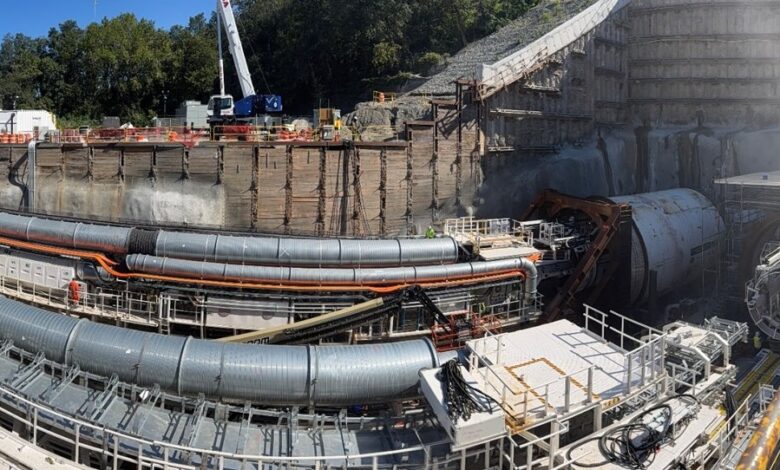
NEW JERSEY — The Gateway Development Commission (GDC) announced that the first tunnel boring machine for the Hudson Tunnel Project has begun mining on schedule, marking a major milestone in construction of the new rail tunnel connecting New Jersey and New York.
A second tunnel boring machine is expected to begin operations in the coming weeks, according to the commission.
The two machines will excavate the first 5,100 feet of the new rail tunnel tubes in New Jersey, extending from the tunnel portal in North Bergen to the Hudson County Access Shaft along the border of Weehawken and Hoboken.

Once the machines reach the access shaft, they will be removed and replaced with a second pair designed to handle the mixed ground conditions beneath the Hudson River.
Each machine is expected to advance approximately 30 feet per day, including scheduled maintenance pauses. Construction of this section of the tunnel tubes is expected to take about one year.
Alicia Glen, New York GDC commissioner and co-chair; Balpreet Grewal-Virk, New Jersey GDC commissioner and co-chair; and Tony Coscia, GDC Amtrak commissioner and vice chair, issued a joint statement celebrating the milestone.
“Before our tunnel boring machine started digging, it had been nearly 120 years since the last train tunnel under the Hudson River was excavated. We are far overdue for an upgrade, and the hundreds of thousands of riders who deal with the fallout from train delays know it. With the start of tunnel boring operations, we showed that we are taking action to deliver the modern infrastructure America needs. We’re grateful for the many partners whose support has enabled us to reach this milestone and committed to continuing to push forward until the job is done.”
GDC Chief Executive Officer Tom Prendergast said the start of tunnel excavation represents the project’s most significant construction milestone to date.
“When the first tunnel boring machine’s cutterhead bit into the rock face in the launch box, GDC reached the most significant Hudson Tunnel Project delivery milestone to date on schedule. This is a major achievement that would not have been possible without the hundreds of people who have worked together to plan, design, and build the infrastructure and equipment needed for this incredible machine to do what it was made to do. GDC, our partners, and the workers on our construction sites will continue to bring the same dedication and grit that enabled us to reach this key milestone on schedule to the project every day until we deliver the reliable rail system Americans deserve.”
The two tunnel boring machines are single-shield machines specifically designed to excavate through hard, dry rock.
Each machine features a cutterhead measuring 28 feet, 8 inches in diameter, along with trailing gantries extending approximately 500 feet. Each weighs more than 1,680 tons.
The machines are designed to excavate and construct the tunnels simultaneously.
As the cutterhead rotates against the rock face, embedded disc cutters break the rock into smaller pieces. The excavated material is collected and transported by conveyor belt to the rear of the machine for removal.
As excavation progresses, an erector arm installs precast concrete segments that form the tunnel’s permanent lining. Hydraulic thrust jacks then push against the completed lining to move the machine forward.
The Hudson Tunnel Project is divided into 10 construction packages. The current tunnel boring operations and construction of the Hudson County Access Shaft are part of the Palisades Tunnel Project package.
Schiavone Lane Dragados JV is leading construction of the package, while the Port Authority of New York and New Jersey is managing project delivery in partnership with the Gateway Development Commission.
The Hudson Tunnel Project is intended to improve rail reliability and capacity along the Northeast Corridor by constructing a new rail tunnel beneath the Hudson River and rehabilitating the existing tunnel, which has been in service for more than a century.