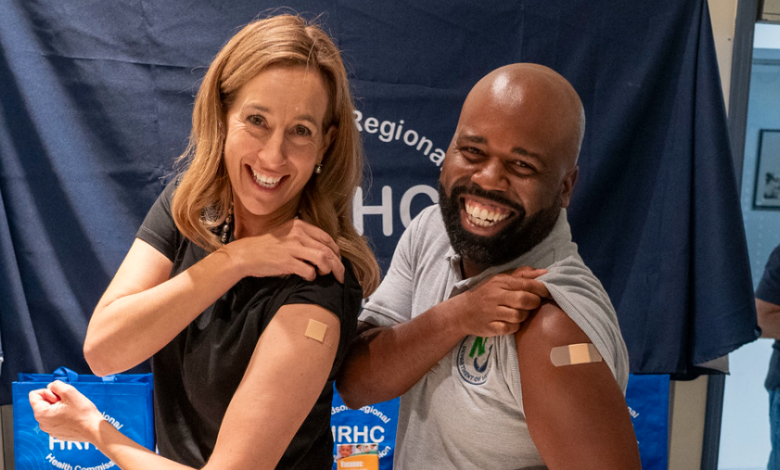
Gov. Sherrill, New Jersey health commissioner receive flu shots, urge vaccinations ahead of respiratory virus season

BAYONNE, N.J. (Hudson County) — Gov. Mikie Sherrill and New Jersey Health Commissioner Dr. Raynard Washington received their annual flu shots Tuesday, Oct. 13, as state health officials encouraged people to get vaccinated against influenza and COVID-19 ahead of the fall and winter respiratory virus season.
Sherrill and Washington joined community members at the Hudson Regional Health Commission’s Vaccines for Children Clinic at the Bayonne Public Library to receive their 2026-27 flu vaccines.
According to the New Jersey Department of Health, seasonal influenza activity in the state remains low but is higher than at the same time last year.

“Staying up to date on your vaccinations is one of the easiest and most effective ways to prevent yourself and your loved ones from getting seriously sick,” said Governor Sherrill. “I encourage all New Jerseyans to make sure they are protected by making a plan to get their seasonal vaccines.”
The clinic was organized by the Hudson Regional Health Commission and Hackensack Meridian Health.
“Getting a flu shot takes just a few minutes, and it’s one of the simplest things any of us can do to protect ourselves, our families, and our neighbors this season,” said Commissioner Washington. “If you haven’t gotten yours yet, now is a great time to talk to your health care provider, stop by your local pharmacy, or find a community clinic near you.”
The Department of Health recommends annual flu vaccinations for everyone 6 months and older, along with updated COVID-19 vaccinations and respiratory syncytial virus, or RSV, protection for those who are eligible.
Adults 65 and older should receive a high-dose flu vaccine when possible, while pregnant and immunocompromised individuals should not receive the nasal spray version of the flu vaccine.
For the 2026-27 respiratory virus season, New Jersey recommends updated COVID-19 vaccines for all children ages 6 through 23 months, children ages 2 through 18 in certain risk groups or if desired, all adults ages 19 through 64, pregnant individuals, immunocompromised individuals ages 6 months and older, and health care personnel.
Adults 65 and older are recommended to receive an updated COVID-19 vaccine and a second dose six months later.
RSV protection is recommended for infants younger than 8 months who were not protected through maternal vaccination and certain children ages 8 through 19 months who are at increased risk.
A one-time RSV vaccination is also recommended during an eligible pregnancy at 32 to 36 weeks, between Sept. 1 and March 1, as well as for adults ages 50 through 74 at increased risk, all adults 75 and older, and immunocompromised adults 18 and older.
Health officials said updated flu and COVID-19 vaccines can be administered during the same visit, along with an RSV vaccine for eligible individuals. Vaccination decisions can also be individualized in consultation with a health care provider.
The state has taken several steps to expand vaccine access ahead of the respiratory virus season.
On Sept. 29, the Department of Health issued Executive Directive No. 26-002, recommending COVID-19 vaccination for everyone 6 months and older during the 2026-27 season.
The department also issued a standing order allowing pharmacy professionals in New Jersey to administer COVID-19 vaccines to anyone 3 years and older without a prescription.
Another directive adopted the American Academy of Pediatrics’ 2026 immunization schedule for children and adolescents and the American Academy of Family Physicians’ 2026 adult immunization schedule.
Under state law, the health commissioner’s recommendations guide vaccine coverage without cost-sharing by state-regulated health insurers and health benefit plans.
In August, the Department of Health launched its “Stay Well, Learn Well” campaign in partnership with hospitals, local health departments and federally qualified health centers to provide vaccinations, physical examinations and health screenings in communities across New Jersey.
Free community health events are continuing through October.
New Jersey is also participating in regional public health partnerships to coordinate vaccination recommendations and responses to communicable diseases.
Sherrill’s final fiscal year 2027 budget includes $3 million for the state’s vaccination program.
Vaccines are available through health care providers, pharmacies, community health clinics and local health departments.
Most health insurance plans cover recommended vaccines. The federal Vaccines for Children program provides no-cost vaccinations to eligible children through age 18, including those who are Medicaid-eligible, uninsured, underinsured or American Indian or Alaska Native.
Adults without insurance or whose insurance does not cover certain vaccines may qualify for free or reduced-cost vaccinations through local health departments and federally qualified health centers.
In addition to vaccination, health officials recommend regular handwashing, covering coughs and staying home when sick to help limit the spread of respiratory illnesses.
More information about vaccination recommendations, eligibility and available services can be found at https://www.nj.gov/health/vaccines.