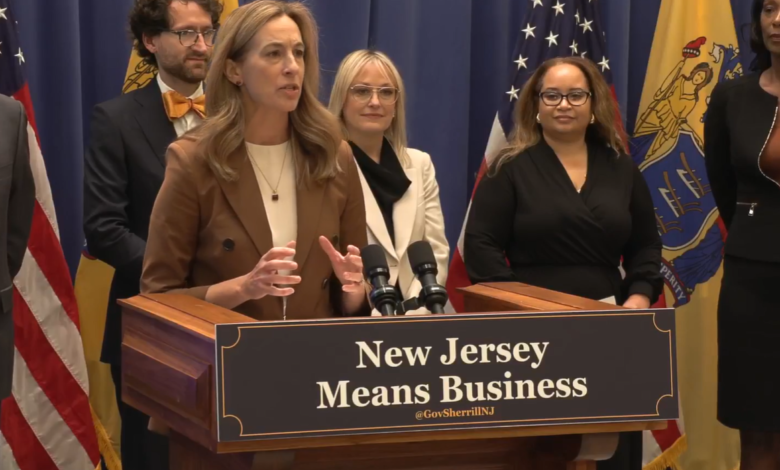
Gov. Sherrill signs executive order to boost New Jersey’s economy, reduce business costs

NEW JERSEY — Gov. Mikie Sherrill has signed an executive order establishing a statewide economic development strategy aimed at reducing business costs, attracting investment, creating jobs and making it easier for companies to start and expand operations in New Jersey.
Executive Order No. 28 establishes the New Jersey Means Business Economic Development Strategy, a coordinated effort involving multiple state agencies to strengthen New Jersey’s economic competitiveness, support existing employers and expand economic opportunities across all communities.

The initiative sets an economic development agenda through 2030, with specific deadlines for state agencies to develop strategies addressing business retention, permitting, workforce development, innovation and access to government services.
“New Jersey has the talent, innovation, and entrepreneurial spirit to build one of the strongest economies in the country. State government needs to match that ambition with a clear strategy and commitment to make our economy more competitive and dynamic,” said Governor Sherrill. “New Jersey Means Business will bring our agencies together to cut unnecessary costs and delays, help businesses grow, and connect our residents with good-paying jobs. This whole-of-government effort will help us build on our strengths as we compete for new investment and ensure economic growth translates to real opportunities for families across our state.”
Four priorities for economic growth
The executive order establishes four major priorities intended to guide New Jersey’s economic development efforts.
The first focuses on improving the state’s business climate by reducing regulatory barriers and operating costs, simplifying permitting procedures, preparing properties for development and strengthening efforts to retain and attract businesses.
The second calls for identifying industries where New Jersey has competitive advantages or opportunities for significant growth. State agencies will work with employers to identify workforce needs, address barriers to expansion and coordinate financial incentives and other resources.
The third priority focuses on research, development and innovation, including stronger collaboration among universities, research institutions, businesses and entrepreneurs. The strategy will also incorporate resources such as the New Jersey Supercomputer Initiative to help turn research into commercial products, new businesses and jobs.
The fourth seeks to ensure that small businesses, workers and communities throughout the state benefit from economic growth. The initiative includes improving access to state services, financing and government contracting opportunities, along with targeted assistance for communities facing persistent economic challenges.
Deadlines established for state agencies
The executive order directs state agencies to develop several initiatives within the next 90 to 150 days.
Within 90 days, the state must develop business retention and attraction strategies, establish a statewide site readiness plan and provide initial recommendations for reducing the cost and complexity of operating a business.
The cost review will examine administrative procedures, overlapping requirements, taxes, fees, licensing and other expenses imposed at different levels of government.
State officials must also convene agencies within 90 days to coordinate permitting and procurement reforms and begin developing an updated statewide workforce and talent strategy.
Within 120 days, the state must identify priority industries for coordinated economic development assistance and recommend changes to existing incentives and funding programs.
Additional 120-day deadlines include developing a statewide research and innovation strategy, improving small-business access to government services and establishing an advisory group representing small and midsized businesses.
The advisory group will include business leaders from various sectors, including historically underrepresented businesses, to provide recommendations on economic growth, business retention and access to capital.
The state must also develop a strategy within 120 days to coordinate economic development in communities facing persistent economic challenges, including efforts aligned with revitalization initiatives in Trenton and Atlantic City.
Within 150 days, New Jersey must establish a coordinated business and permitting navigation service for qualifying projects. The service will bring together state and municipal permitting, regulatory reviews, workforce development and other resources to help businesses navigate expansion and investment projects.
New council to oversee implementation
The executive order establishes the New Jersey Means Business Economic Development Council to coordinate implementation and track progress.
The council will report to the governor’s chief operating officer and be chaired by the senior director of strategic initiatives and economic opportunity.
Participating agencies will include the New Jersey Economic Development Authority, New Jersey Innovation Authority and the departments of State, Labor and Workforce Development, Community Affairs and the Treasury.
NJEDA CEO Evan Weiss said the initiative follows discussions with business owners and entrepreneurs about the state’s economic challenges and opportunities.
“After months of conversations with business leaders and entrepreneurs, the signing of today’s Executive Order represents a bold step forward for New Jersey’s economic future,” said NJEDA CEO Evan Weiss. “I look forward to working with Governor Sherrill, the Legislature, and industry leaders on advancing an economic growth agenda that bolsters our economic competitiveness, expands opportunities for business owners in every corner of the state, and strengthens the Garden State’s nation-leading innovation ecosystem.”
New Jersey State Chief Innovation Officer Dave Cole said improving online government services and simplifying regulatory procedures will be important components of the strategy.
“The Governor is making it clear today that the State government will listen to New Jersey businesses and work closely with them,” said New Jersey State Chief Innovation Officer Dave Cole. “Through expanding resources like Business.NJ.gov and improving the customer experience in permitting and licensing, we’re working to make doing business in NJ as simple, streamlined, and intuitive as possible.”
Lt. Gov. and Secretary of State Shirley U. Emehelu said the executive order reflects efforts to address concerns raised by employers.
“Today’s Executive Order reflects the Governor’s commitment to strengthening New Jersey’s business climate and promoting economic growth. This is a perfect example of responsive government taking action and implementing the change that companies, large and small, have been requesting for some time,” said Lieutenant Governor and Secretary of State Shirley U. Emehelu. “The hallmarks of this administration are creating opportunity and being accountable. Today, this executive order accomplishes both goals by hearing the concerns of our job creators and creating the pathway for them to succeed in our state.”
Focus on workforce development and communities
The strategy also calls for aligning workforce training, apprenticeships and employment services with industries expected to experience growth.
“New Jersey’s economy works when both workers and employers do well,” said Acting Labor Commissioner Kevin D. Jarvis. “NJDOL will align our training, apprenticeship, and employer services with where the economy is headed, while keeping standards strong to uplift all Garden State workers. We thank Governor Sherrill for her leadership in setting this course.”
Department of Community Affairs Commissioner Jacquelyn A. Suárez said housing availability and local development opportunities will also play a role in the state’s economic strategy.
“Governor Sherrill heard directly from New Jersey residents and businesses across all 21 counties, and this strategy answers what they told her. Economic growth depends on strong communities,” said DCA Commissioner Jacquelyn A. Suárez. “That means lifecycle housing that serves residents at every stage of life, and towns equipped to welcome new investment to strengthen their tax base. DCA is ready to do its part to make New Jersey easier to build in, easier to grow in, and a place where every community shares in our success.”
State Treasurer Aaron Binder said the administration intends to make New Jersey more competitive through regulatory changes, innovation and targeted investments.
“Governor Sherrill’s economic plan is a turning point for New Jersey,” said State Treasurer Aaron Binder. “By cutting red tape, driving innovation, and providing targeted industry investments, this administration is creating a highly competitive, business-friendly environment that gives every community across our state the tools to thrive.”
Business leaders respond to the initiative
Several business and economic development leaders expressed support for the executive order.
Ketan Mehta, founder and CEO of Tris Pharma, said supporting existing New Jersey businesses is just as important as attracting new companies.
“Tris Pharma started in New Jersey more than twenty-five years ago, and the talent, research strength, and partnerships we found here are why we have grown here ever since,” said Ketan Mehta, Founder and CEO of Tris Pharma. “This strategy recognizes that supporting companies like ours to keep investing and expanding is just as important as attracting new ones, and we are proud to stand behind it.”
Amy Herbold, president and CEO of Choose New Jersey, said the organization plans to work with the administration to advance the economic development strategy.
“Choose New Jersey is ready to work alongside Governor Sherrill’s Administration, in step with the New Jersey Means Business Executive Order. This economic plan is exactly what the state needs to create a more transparent, efficient, and competitive business ecosystem,” said Amy Herbold, President and CEO, Choose New Jersey. “Through our close relationships with New Jersey’s business leaders, we understand what companies need to invest, create jobs, and grow in the state. We look forward to continuing to turn those insights into meaningful progress for New Jersey.”
Ayo Sanderson Wilson, president and CEO of Empower The Village, emphasized the importance of including smaller businesses in the state’s economic plans.
“There is nothing small about small business! Small business is the engine of wealth in New Jersey and across America,” said Ayo Sanderson Wilson, President and CEO, Empower The Village. “We know that small business owners have BIG dreams. And when those dreams become thriving enterprises, they create jobs, build wealth, strengthen families, and transform communities. That’s why I’m excited by Governor Sherrill’s Executive Order and its commitment to measurable action.”
Tracking economic progress
Under the executive order, participating agencies must establish implementation milestones and performance measures to evaluate the strategy’s effectiveness.
Those measures will include employment, wages, business formation and private investment. State agencies will also coordinate with employers, business organizations and other stakeholders as they develop and implement the required initiatives.
The strategy will be aligned with the administration’s existing permitting and procurement reform efforts to improve coordination and accountability across state government.
Businesses seeking information about state programs and assistance can visit Business.NJ.gov.