AAA study finds automatic emergency braking systems struggle to prevent some intersection crashes

Automatic emergency braking systems designed to prevent crashes at intersections are showing improvements, but new AAA research found the technology still has significant limitations in certain collision scenarios.
AAA tested four 2026 model-year vehicles equipped with intersection automatic emergency braking, or AEB, systems to determine how effectively the technology responds to different crash situations. While all four vehicles successfully avoided collisions during a standardized left-turn test, three of the four systems failed to prevent a collision when another vehicle turned into their path from a side road. The findings highlight differences in how the systems perform under standardized testing conditions compared with other potentially dangerous intersection situations.

“Intersections are some of the most dangerous places on the road, said Greg Brannon, AAA’s Director of Automotive Engineering and Research. “AEB is making progress in the limited intersection scenarios it is tested to handle. Unfortunately, performance outside those scenarios is spotty.”
Automatic emergency braking systems use sensors and other technology to detect potential collisions and automatically apply the brakes when a driver fails to respond in time. Although the systems have traditionally focused on preventing rear-end crashes, newer versions are designed to recognize more complex situations, including vehicles crossing or turning into traffic at intersections.
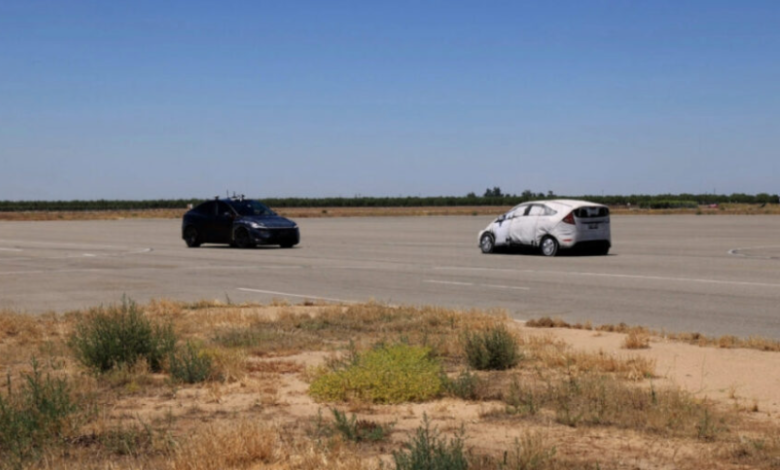
AAA conducted the research in partnership with the Automobile Club of Southern California’s Automotive Research Center, using four 2026 model-year vehicles with intersection AEB included as standard equipment. Researchers performed 74 closed-course test runs under controlled daytime conditions, evaluating two primary intersection crash scenarios and several variations in vehicle movements.
In the first scenario, known as turn-into-path, a robotic vehicle target made a right turn from a perpendicular road into the path of a test vehicle traveling straight at 30 mph. The turning vehicle was moving at 5 mph. Three of the four vehicles failed to avoid a collision in that scenario, demonstrating limitations in detecting and responding to vehicles entering traffic from side roads.
The second scenario involved a vehicle making a left turn across the path of oncoming traffic. Under standardized European New Car Assessment Programme testing conditions, all four vehicles successfully avoided collisions. For that test, the vehicle making the left turn traveled at approximately 9.3 mph, while the approaching vehicle traveled at approximately 18.6 mph. The test vehicle’s turn signal was activated, and a steering robot controlled the maneuver.
AAA also evaluated variations of the left-turn scenario, including tests conducted without an activated turn signal and tests in which a driver manually steered the vehicle instead of a robotic system. According to AAA, current vehicle safety testing standards do not fully account for the variety of intersection crashes that occur on American roads.
Historically, U.S. testing protocols for vehicle-to-vehicle automatic emergency braking have focused primarily on rear-end collisions. In 2020, Euro NCAP introduced limited intersection testing, including left turns across oncoming traffic. The National Highway Traffic Safety Administration developed a draft Intersection Safety Assist testing procedure in 2019 for research purposes, but a final standard has not been implemented.
The latest findings represent an improvement over AAA research conducted in 2022, when four vehicles equipped with standard AEB systems were tested in two common intersection crash scenarios. During those earlier tests, none of the systems provided collision warnings or automatically applied the brakes in any of the test runs.
AAA is encouraging automakers to work with researchers, regulators and safety organizations to improve intersection AEB performance across a wider range of crash situations and real-world driving conditions. The organization also recommends expanding vehicle safety testing protocols to include additional intersection configurations, particularly situations involving vehicles turning into the path of approaching traffic.
For motorists, AAA emphasized that automatic emergency braking should be considered an additional safety feature rather than a substitute for attentive driving. Drivers approaching intersections should remain alert for vehicles that may unexpectedly enter their path and be prepared to brake or steer to avoid a collision.
AAA also recommends that drivers consider “covering the brake” when entering intersections by positioning their right foot just above the brake pedal, with their heel resting on the floor, allowing them to react more quickly if necessary. The organization said continued improvements in testing and technology are needed to make intersection automatic emergency braking systems more effective across a broader range of driving conditions.
The complete findings and testing methodology are available in AAA’s 2026 intersection automatic emergency braking report.