

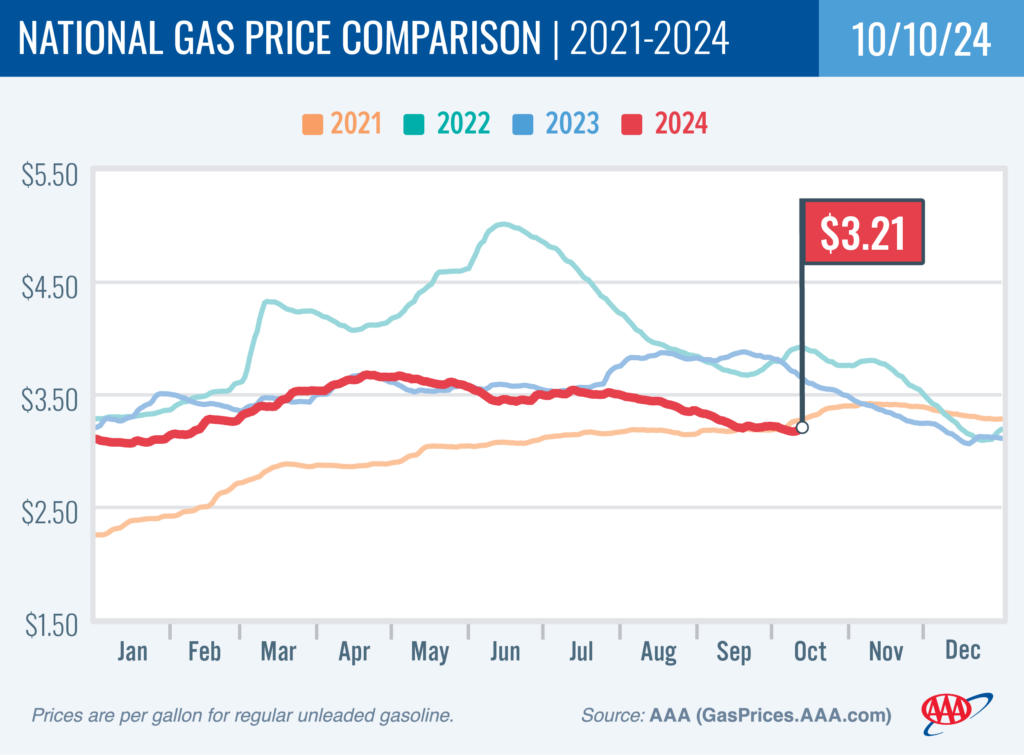
The national average for a gallon of gas popped two pennies higher to $3.21 since last week as large swaths of the country deal with severe back-to-back storm damage, according to AAA.
Like Hurricane Helene, Milton will not severely impact national gasoline supplies but will affect demand in areas with destroyed infrastructure, flooded roads, and power outages, AAA said.
Overseas, the tension between Iran and Israel continues, which is causing a slow wobbling in the price of oil but no steady upward movement.

“All this terrible weather lately could cause regional prices to rise as drivers flock to the few open stations with gas,” said Andrew Gross, AAA spokesperson. “But as roads are cleared and power is restored, stations will be able to be re-supplied, so any upward pressure on prices should be fleeting.”
With an estimated 1.2 million AAA members living in households with one or more electric vehicles, AAA tracks the average kilowatt-per-hour cost for all levels of public charging by state. Today’s national average for a kilowatt of electricity at a public charging station is 35 cents.
According to new data from the Energy Information Administration (EIA), gas demand surged from 8.52 million b/d last week to 9.65. Meanwhile, total domestic gasoline stocks plunged from 221.2 million barrels to 214.9, while gasoline production increased last week, averaging 10.2 million barrels daily.
Today’s national average for a gallon of gas is $3.21, 5 cents less than a month ago and 47 cents less than a year ago.
At the close of Wednesday’s formal trading session, WTI fell by 33 cents to settle at $73.24 a barrel. The EIA reports that crude oil inventories increased by 5.8 million barrels from the previous week. At 422.7 million barrels, U.S. crude oil inventories are about 4% below the five-year average for this time of year.
Quick Gas and Electricity Stats
Gas
The nation’s top 10 most expensive gasoline markets are California ($4.67), Hawaii ($4.59), Washington ($4.05), Nevada ($3.91), Oregon ($3.67), Alaska ($3.65), Illinois ($3.50), Utah ($3.50), Idaho ($3.44), and Pennsylvania ($3.38).
The nation’s top 10 least expensive gasoline markets are Georgia ($2.72), Mississippi ($2.75), Texas ($2.80), Arkansas ($2.81), Oklahoma ($2.81), Louisiana ($2.83), Missouri ($2.84), Kansas ($2.84), Alabama ($2.86), and Tennessee ($2.86).
Electric
The nation’stop 10 least expensive states for public charging per kilowatt hour are Kansas (22 cents), Missouri (24 cents), Delaware (26 cents), Nebraska (28 cents), Texas (29 cents), Vermont (30 cents), Michigan (30 cents,) Utah (30 cents), Wisconsin (30 cents), and North Dakota (30 cents).
The nation’s top 10 most expensive states for public charging per kilowatt hour are Hawaii (55 cents), West Virginia (45 cents), Montana (43 cents), Arkansas (42 cents), Idaho (42 cents), New Hampshire (42 cents), South Carolina (42 cents), Kentucky (41 cents), South Dakota (41 cents), and Alaska (41 cents).
Drivers can find current gas and electric charging prices along their route using the AAA TripTik Travel planner.


