

As you prepare to shop for the Thanksgiving meal, don’t expect tremendous savings. Despite food-at-home inflation slowing to 2.4% since last October, this year’s celebration will not be less expensive, according to a recent report from Wells Fargo on holiday dinner costs.
That’s because there are record price spreads between the wholesale price supermarkets pay versus the retail prices consumers pay – and the difference is impacting some of the most popular holiday dishes, including turkey and ham. Prices for other categories are up too, so consumers will need to be conscious of sales and shopping early. Although many won’t feel relief at the grocery store, those who reside in the states responsible for bringing holiday food items to our Thanksgiving tables may have a reason to celebrate.
Talk turkey to me
As of November 6, turkeys will cost consumers 16% less this year, despite a 29% drop in wholesale prices.
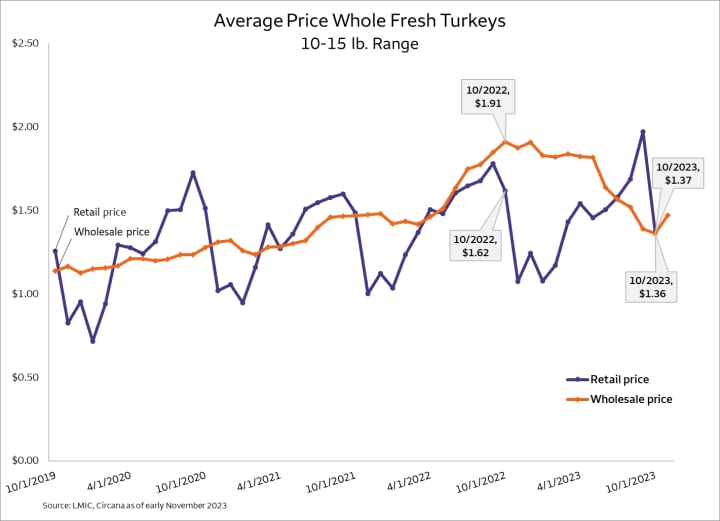
Retail turkey prices (what consumers pay) for whole fresh turkeys averaged $1.37 per lb., down 16% or $0.26 per lb. from October of last year. At the same time, the wholesale price of turkeys (what supermarkets pay) dropped from $1.91 a lb. to $1.36 per lb., down 29% or $0.55 per lb. from October of last year. This translates to a price spread of $0.01 per lb. – up from last year’s negative spread of $0.29 per lb.
So, what’s going on? Every year, retail turkey prices drop sharply as we approach the all-important Thanksgiving Day buying rush. Retailers use turkeys as a key driver of store traffic volume, with 84% of whole fresh turkeys being sold in November. And, it’s likely that this seasonal dynamic will remain true. However, given that the original wholesale to retail spread started from such an elevated point, it’s unlikely the consumer will see the complete benefit of the drop in wholesale turkey prices. The burden is falling on turkey producers who bought historically expensive feed to ready turkeys for their big day. This shifting of margin contraction back onto the agricultural producers and food manufacturers creates risk to the financial stability of those producing the food.
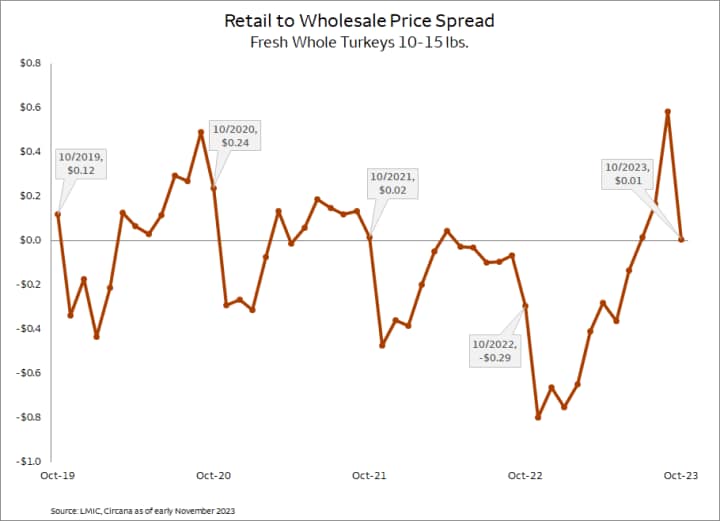
Can the supermarkets and food retailers hang on to this historically high spread? Maybe temporarily, but the supermarket sector is incredibly competitive. With most food manufacturers operating at full speed based on employment growth and automation, there will be intense pressure on retailers to pass along savings to consumers in the bid for consumer shopping dollars. The retail food sector faces the same fundamental dynamics it did before the COVID disruption, and recent consolidation shows that the sector remains as competitive as ever.
The only real question is whether turkey prices will fall fast enough – before consumers buy that special part of the big family meal. And for those keeping track, the Midwest power states (MN, IN and IA) produce 59% of the country’s turkey birds.
Call the ham-bulance, ham hits near all-time high
Retail ham prices are near an all-time high with a price of $4.56 per lb. in September, up 5.2% from last year. The wholesale versus retail price spread is also historically large and continues to expand each year. If you prefer ham to turkey as your main dish, or like to have both proteins on the table, then you can thank the hog producers in the Midwest, who raise around 87% of U.S. hogs. High feed costs and low hog prices limited expansion from hog producers this year, keeping pork production stable. However, don’t expect stable ham prices at the grocery store this year for the same reason explained for turkey.
Cran-tastic cranberries
Consumers can expect to pay about 20% less for fresh cranberries compared to a year ago, while recent data shows canned cranberry sauce is up 7% compared to last year. For the cranberry lover, the sauce originates from four major regions in the U.S., with Wisconsin leading the way, followed by Massachusetts, New Jersey and the Pacific Northwest.
Sweet potatoes (it’s really one-word!)
Sweet potatoes are a Thanksgiving favorite that is versatile, tasty, and friendly to the wallet. Nearly two thirds of America’s sweet potato production comes from North Carolina, and due to controlled environments for storage, sweet potatoes can be grown commercially and stored year-round. For this reason, sweet potatoes are a great value for the dinner plate. Consumer prices are currently up 4% from a year ago.
Peelin’ the burn on potatoes
Russet potatoes retail prices are at all-time highs, with costs coming in at $1.17 per lb. in September, up from $1.08 last year at that time. Consumer prices are currently up 14% from a year ago. Growers report much lower farm gate prices, which implies another example of a larger markup for the consumer versus retailer, just like turkeys. Idaho and Washington produce the most commercially grown potatoes.
Canning the green bean casserole
Who doesn’t like green bean casserole at Thanksgiving? While produce remains inflation resilient, products that are processed have increased in price due to energy and raw materials costs. On average, canned green beans are up almost 9% from this time last year. Green beans, if not purchased fresh, will likely be more expensive in the store this year. If a fan of green beans, you can thank Wisconsin which produces 44% of America’s green beans, of which more than two-thirds of the crop is processed into canned and frozen products. This said, make sure you scan the grocery store flyers and shop Thanksgiving sales.
Long live leafy greens
As Americans continue to consider healthy eating options, salads have been a growing trend on the Thanksgiving plate. California and Arizona produce the majority of all the leafy greens enjoyed by Americans. Last year, weather and disease hindered the lettuce crop, driving prices up in November 2022. However, this year, there is plenty of supply, and salads are another value option for the table. Consumer prices for Romaine lettuce are currently down approximately 10% from a year ago.
When life gives you pumpkins, make pie
If you are looking forward to pumpkin pie this year, you can give thanks to the state of Illinois. While pumpkins are grown in every state, Illinois grows 38% of America’s crop, and one major canner headquartered in Illinois, processes 90% of Illinois’ pumpkins into canned product used for breads and pie fillings. Costs for canned pumpkins are currently 30% higher this year from last year.
Sip, sip, hooray! Where there’s wine, there’s a way
Celebratory beverages have also seen their inflation continue through October’s report. Beer is up 5.3% from this time last year. This beer sector has seen some of the most persistent inflation due to aluminum, transportation and labor costs. However, wine has only increased 1.2% from this time last year, and year-over-year retail prices for wine actually fell for the first four months of 2023. What accounts for the very different behavior between beer and wine? The global supply of wine makes it difficult for domestic producers to raise prices, and the recovery of the global shipping market will ensure that wine reaches stores for the big celebration.
Thank you to all of our country’s growers
While the ingredients for most of our Thanksgiving dishes originate in the Midwest, it takes contributions from all regions to truly complete the meal. For consumers on the East and West Coasts, meal ingredients travel many miles to the table, unlike for those consumers in the Midwest where ingredients travel only a short distance to be gobbled. A big thank you to all of the growers, producers and manufacturers up and down the food chain for supplying our Thanksgiving feast.


