National gas prices remain above $4 a gallon as crude oil prices stay high, AAA says

The national average price for a gallon of regular gasoline dropped slightly over the past week but remains above $4 as crude oil prices continue to hover near $100 per barrel, according to AAA.
As of Thursday, Oct. 15, the national average stood at $4.33 per gallon, down about 3 cents from $4.36 a week earlier. Prices have remained above $4 since late July and are more than $1 higher than at the same time last year, when the average was $3.07.
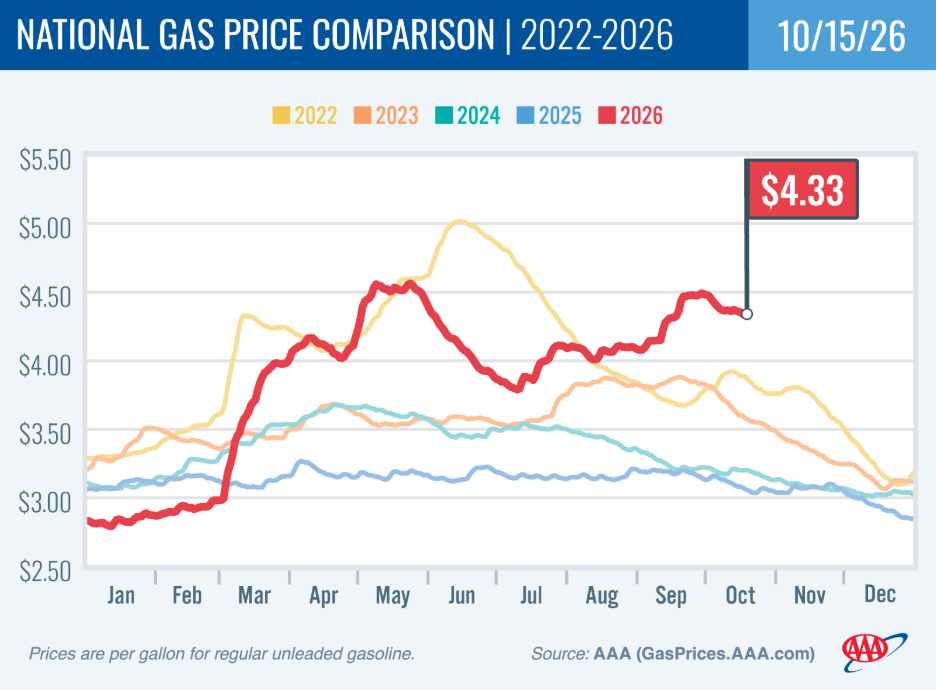

According to AAA, gasoline prices typically decline during the fall months as seasonal demand decreases. However, volatility in the oil market has contributed to unusually high prices for this time of year.
The national average was $4.33 a month ago, indicating that prices have remained relatively unchanged despite fluctuations in crude oil costs.
New data from the U.S. Energy Information Administration (EIA) showed gasoline demand declined from 8.76 million barrels per day to 8.40 million barrels per day last week. Meanwhile, total domestic gasoline supplies increased from 204.7 million barrels to 208.3 million barrels.
Gasoline production also decreased during the week, falling from 9.34 million barrels per day to 9.23 million barrels per day.
Crude oil prices remained elevated, with West Texas Intermediate crude rising 95 cents Wednesday to settle at $95.09 per barrel. The EIA reported that U.S. crude oil inventories declined by 8.6 million barrels to 415.6 million barrels, approximately 3% below the five-year average.
AAA reported that California had the nation’s highest average gasoline price at $6.23 per gallon, followed by Hawaii at $5.63 and Washington and Nevada at $5.42 each. Other states with some of the highest prices included Oregon at $4.97, Alaska at $4.96, Idaho at $4.85, Utah at $4.82, Illinois at $4.69 and Arizona at $4.66.
North Carolina had the lowest average gasoline price at $3.70 per gallon, followed by Georgia at $3.77 and Texas at $3.83. Tennessee averaged $3.88, Indiana $3.89, Louisiana and South Carolina $3.90 each, Mississippi $3.91, Arkansas $3.93 and Alabama $3.94.
For electric vehicle drivers, AAA reported that the national average cost of electricity at public charging stations remained unchanged at 41 cents per kilowatt-hour.
Hawaii had the highest average public charging cost at 54 cents per kilowatt-hour, followed by West Virginia at 52 cents and Louisiana at 49 cents. California averaged 47 cents, while Alaska and New Hampshire averaged 46 cents.
Other states among the most expensive for public EV charging included Arkansas, North Dakota and Arizona at 44 cents per kilowatt-hour, and Nevada at 43 cents.
Kansas and Missouri had the lowest average public charging costs at 32 cents per kilowatt-hour, followed by Iowa at 33 cents and Nebraska at 34 cents. Maryland, South Dakota and Utah averaged 35 cents, Vermont 36 cents, and Minnesota and New Mexico 37 cents.
AAA encourages motorists to compare gasoline and electric vehicle charging prices along their routes using its TripTik Travel Planner.