New Jersey rideshare drivers rally against autonomous vehicle bill, call for union rights

TRENTON, N.J. — Rideshare drivers and labor groups rallied outside the New Jersey State House on Thursday to oppose legislation that would establish a three-year autonomous vehicle pilot program and to call for collective bargaining rights and protections from potential job displacement.
Drivers joined members of 32BJ SEIU, the App Drivers Union and the International Association of Machinists and Aerospace Workers, along with elected officials, labor leaders and community organizations, to launch the “I AM HUMAN” campaign.
Participants called on lawmakers to halt S-1677, sponsored by state Sens. Andrew Zwicker and Gordon Johnson, which would require the New Jersey Department of Transportation, in consultation with the New Jersey Motor Vehicle Commission, to establish a three-year pilot program allowing authorized testers to operate fully autonomous vehicles in closed and open-road test environments. The Senate Transportation Committee advanced a substitute version of the legislation May 11, and it was referred to the Senate Budget and Appropriations Committee.

Drivers and labor organizations at Thursday’s rally said they are concerned that allowing companies such as Waymo to test and eventually operate commercial driverless services could displace rideshare drivers before workers have a voice in how automation affects their jobs.
“New Jersey must put workers before Waymo,” said Ana María Hill, New Jersey State Director and Vice President of 32BJ SEIU. “We are not against innovation—but innovation cannot come at the expense of working people. Before Waymo gets a green light in New Jersey, drivers need enforceable union rights and a seat at the table. Technology should serve working people, not replace them.”
The groups said an estimated 100,000 drivers across New Jersey rely on rideshare work to support themselves and their families. Drivers at the rally described working long hours while paying for gasoline, insurance and vehicle maintenance, often without access to health care, paid leave or protections against sudden deactivation from rideshare apps.
Drivers and labor allies also called for legislation that would give app-based rideshare drivers the right to choose a union and collectively bargain over compensation, benefits, working conditions and protections against what they describe as unfair deactivation.
Driver Elizabeth Figueroa Núñez, a single mother of two who has driven for app-based companies for four years, said she was hospitalized after being assaulted by a passenger earlier this year.
“A passenger assaulted me, first struck me in the eye, pulled out a knife and tried to attack me twice with the knife while I was doing my job,” Figueroa Núñez said. “I ended up in the hospital. When I called Uber to report what happened and ask for help, I did not receive the protection or support I needed and instead, Uber deactivated me. I risked my life doing this work, but when I needed the company to stand behind me the most, I was left alone.”
“My children depend on the income I earn as a driver, yet I have no health insurance or real protection when something happens to me,” Figueroa Núñez continued. “We are not machines, we are mothers, fathers and workers. We deserve the right to organize, safe working conditions and protection from unfair deactivation before corporations are allowed to replace us with robot cars.”
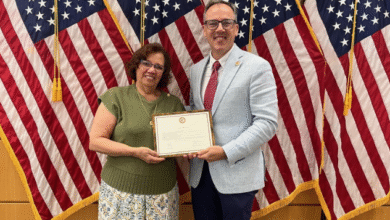
Assemblyman Gary Schaer also spoke in support of the drivers.
“Every day, thousands of New Jerseyans rely on rideshare drivers to get to work, make appointments, and go about their daily lives. That is especially true in places like Passaic, where many do not have access to a car and rely on drivers to get to where they need to go, or depend on driving as their primary source of income. Despite the essential service that rideshare drivers provide to our communities, many are struggling to make ends meet. Without a union, drivers can lose access to their livelihood without warning from companies like Uber or Lyft, with little representation and no transparent process to repeal these decisions. I stand with 32BJ SEIU and rideshare drivers of the App Drivers Union in their demand to create a union for better wages and benefits, better working conditions, and greater respect.” Said Assemblyman , Gary Schaer.
When the autonomous vehicle legislation advanced in May, Zwicker said the pilot program would allow New Jersey to evaluate and develop the technology.
“New Jersey has the opportunity to lead the northeast in developing safe and efficient autonomous vehicle technology that will revolutionize how we travel,” said Senator Zwicker, D-Middlesex, Mercer, Somerset and Hunterdon. “By initiating this program, we will lay the groundwork for massive improvements to our transit infrastructure, building off of years of autonomous vehicle research to improve public safety and expand access to reliable transportation.”
The current Senate committee substitute calls for a nine-member task force to oversee the program and requires participating testers to meet a series of safety, insurance, reporting and operational requirements. It also allows an authorized tester to operate a fully autonomous vehicle without a human driver if specified requirements are met.
“Autonomous vehicle technology is rapidly advancing, and we must work to ensure that it is safe before its full implementation on our roads,” said Senator Johnson, D-Bergen. “This program establishes strong safeguards and clear oversight measures that will allow the state to responsibly evaluate the technology without risking the safety of our communities.”
Under the committee substitute, autonomous vehicles in the pilot program would be subject to safety requirements, and certain crashes would have to be reported to the Department of Transportation within five calendar days after a tester receives notice of the crash. The legislation would also prohibit pilot-program autonomous vehicles from operating in school zones, construction zones and areas determined by the state to have high rates of pedestrian collisions.
The Department of Transportation would also be directed to establish new autonomous vehicle testing environments and identify funding sources for smart infrastructure, including sensor-equipped roads, communication systems and real-time traffic management technology. No later than six months after the three-year pilot concludes, the department would submit a report to the governor and Legislature evaluating the program and making recommendations for safely integrating autonomous vehicles on New Jersey highways.
At Thursday’s rally, drivers carried signs calling for union rights and opposing driverless vehicles as speakers urged lawmakers to address their concerns about pay, health care, safety and deactivation before expanding autonomous vehicle operations.
“Human drivers are already struggling for fair pay, healthcare, safety and protection from unfair deactivation,” Hill added. “New Jersey cannot allow their jobs to disappear before they ever receive those basic rights. No robot cars without union rights.”