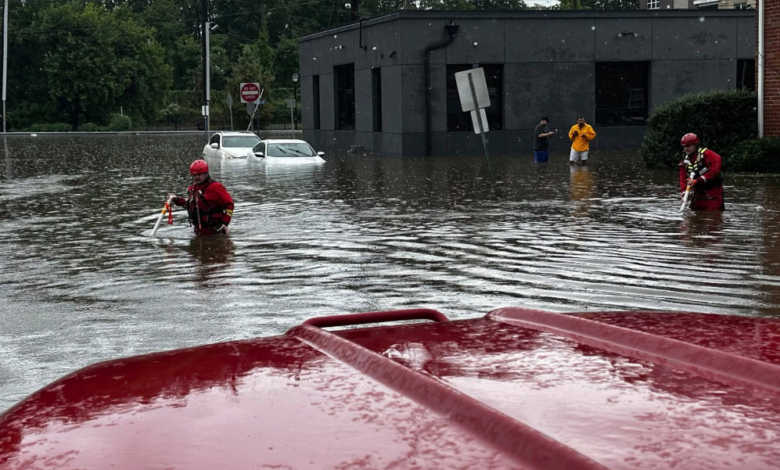
‘Once-in-a-generation’ rainfall recorded in North Haledon as heavy rain hit New Jersey

NEW JERSEY — A stalled weather front and slow-moving area of low pressure produced extreme rainfall across parts of New Jersey on Sunday morning, with one Rutgers University weather station recording more than 4 inches of rain in three hours.
From 7 to 10 a.m., the Rutgers University New Jersey Weather Network station in North Haledon recorded 4.03 inches of rain. Based on climatological estimates from the National Oceanic and Atmospheric Administration, rainfall of that magnitude has a return period of approximately 80 years.
“The atmosphere was completely saturated and ‘juiced up'”, said John Krasting, New Jersey State Climatologist of Rutgers University. “Once the rain started, it just didn’t let up. Parts of Passiac and Bergen counties took it on the chin, once again. Our preliminary estimates are that this is at least a once-in-a-generation event in towns such as North Haledon, Haworth, and Little Falls.”


Other areas of northern and central New Jersey also received significant rainfall. As of 12:30 p.m. Sunday, the New Jersey Weather Network reported the following daily rainfall totals:
- North Haledon: 4.95 inches
- Haworth: 4.54 inches
- Little Falls: 4.43 inches
- Parsippany: 3.77 inches
- Hamilton: 2.37 inches
- Chester Borough: 2.31 inches
- Cream Ridge: 2.08 inches
Rutgers said heavy rainfall events are becoming more frequent as the climate warms.
“For every 2 degrees [Fahrenheit] that the atmosphere warms, it can hold 7 to 8% more water vapor,” says Krasting. “Recent studies and published reports, such as the Fifth National Climate Assessment, show the frequency of heavy rainfall events are increasing here in New Jersey. Just take a look at this summer: the same areas that saw the punishing rains today were the same areas caught up in similar flooding in late July and early August.”
The New Jersey State Climate Office, located at Rutgers University and the New Jersey Agricultural Experiment Station, operates the New Jersey Weather Network, which consists of 70 weather stations across the state that monitor conditions every five minutes.
The network provides real-time weather information and participates in the National Mesonet Program, which supplies data to the National Weather Service to help improve forecasts.