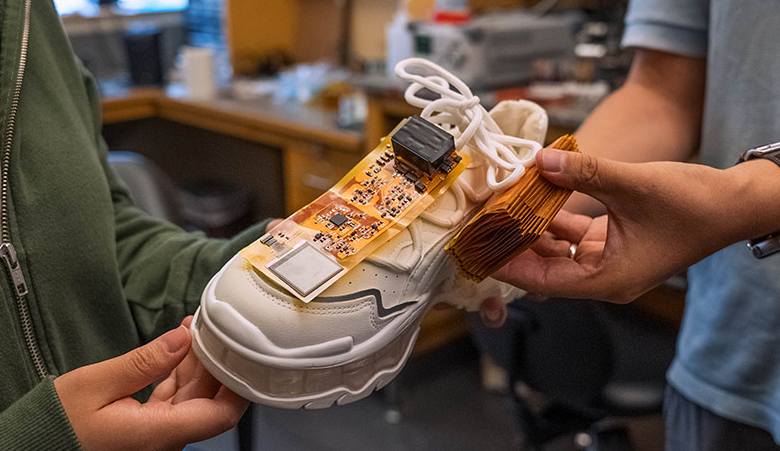
NEW JERSEY — Rutgers University engineers have developed a battery-free smart shoe that can analyze how a person moves, technology researchers say could eventually help monitor people with Parkinson’s disease, spinal cord injuries, traumatic brain injuries and other movement disorders.
The prototype can distinguish different types of movement with 95.4% accuracy while also counting steps and estimating calories burned. Unlike many wearable devices, the shoe does not require a rechargeable battery because it generates energy from the wearer’s footsteps.
The research, led by Simiao Niu, a biomedical engineer at Rutgers University-New Brunswick, was published in the journal Science Advances.

“When you are walking or running, you automatically have biomechanical energy available, so you can harvest this energy,” said Niu, an assistant professor in the Department of Biomedical Engineering at the Rutgers School of Engineering.
Niu said a shoe was a natural choice because walking produces both the information researchers want to analyze and the energy necessary to study it.
“When you sit down, there is no energy available, but you don’t need gait monitoring,” Niu said.
A device embedded in the shoe’s sole produces electricity from the pressure and friction generated with each step. The process, known as the triboelectric effect, is related to the static electricity created when different materials rub together.
Because the electricity is initially generated in irregular bursts that cannot be used directly by the electronics, researchers developed a power-management circuit to convert it into a usable form. The system increased usable energy by as much as 120 times compared with a conventional method.
Researchers are particularly interested in gait — a person’s pattern of walking, including balance, speed, stride and rhythm. Changes in gait can provide information about disease progression, fall risk and rehabilitation.
“Gait is one of the most significant biomarkers for a lot of diseases,” said Niu.
Doctors often assess gait by watching a patient walk for a short period in a clinic or laboratory. Researchers say a wearable device could eventually allow movement to be monitored over longer periods while people go about their daily lives.
“If you are able to use what I call the ‘worry-free shoes’ we’ve developed, patients can just wear them, and the shoes can automatically collect their gait pattern,” Niu said.
With additional development and clinical testing, the technology could potentially be used to assess fall risk, detect unusual walking patterns or track recovery following a brain or spinal cord injury. Researchers said the design could also potentially be adapted to monitor heart activity, biochemical signals and other health information.
The current prototype consists of white athletic shoes with electronics concealed in the heels. Niu emphasized that the technology remains an early prototype and is not a medical device. It cannot diagnose a disease, predict a fall or determine whether a treatment is working.
The research also seeks to address what Niu calls the “energy-intelligence bottleneck” facing wearable technology. Smartwatches and other wearable devices can collect large amounts of information that artificial intelligence can analyze, but more advanced AI functions can also consume more power.
“We want to solve the fundamental bottleneck in current wearable devices,” Niu said. “We are developing a smart wearable with integrated AI functionality that can harvest energy on its own, so you don’t need to worry about charging.”
Niu previously worked at Apple, where he helped develop an electrocardiogram sensor for the Apple Watch. He said health monitoring stops when a wearable device has to be removed for charging, and users may not always remember to put it back on.
“Once you put it onto the charger, you typically forget about it, and then you don’t wear it,” Niu said. “Those wearables cannot monitor your health if you just leave them in your drawer.”
The Rutgers prototype uses an accelerometer to measure foot movement along three axes — x, y and z. A small processor equipped with AI analyzes the measurements and classifies each 15-second period as one of four activities: slow walking, fast walking, running or climbing stairs. Results are displayed on a screen attached to the shoe.
The analysis is performed within the wearable itself, an approach known as “edge AI.” Because the shoe does not need to continuously transmit raw data to a phone, computer or cloud server, it uses significantly less energy.
Researchers also had to reduce the size of the AI algorithm so it could fit within the processor’s limited memory. The original model examined 21 characteristics of movement and achieved 98.1% accuracy but required more memory than the processor could accommodate.
The team determined that variations in movement along the three axes provided most of the information needed by the AI algorithm. The smaller model achieved 95.4% accuracy while operating about 15 times faster and using about one-sixth as much current.
The sensor and AI algorithm together consume 86 microwatts. Researchers found in laboratory testing that even slow walking generated enough electricity to operate the complete system.
Fuying Dong, a Rutgers biomedical engineering doctoral student and the study’s first author, said developing the prototype required researchers to approach the shoe as an interconnected system.
“The idea of how to co-design the whole system is the best thing I learned from this project,” Dong said. “You break a huge project into smaller pieces, finish them one by one, and try to figure out what’s the biggest story behind it.”
The prototype was developed using data collected from four healthy volunteers between the ages of 23 and 26. The AI algorithm has so far been trained and tested only on the activities included in the study and has not been tested on older adults, people with movement disorders or patients undergoing rehabilitation.
Niu, Dong and Chi Han are listed as inventors on a Rutgers provisional patent application related to the technology.