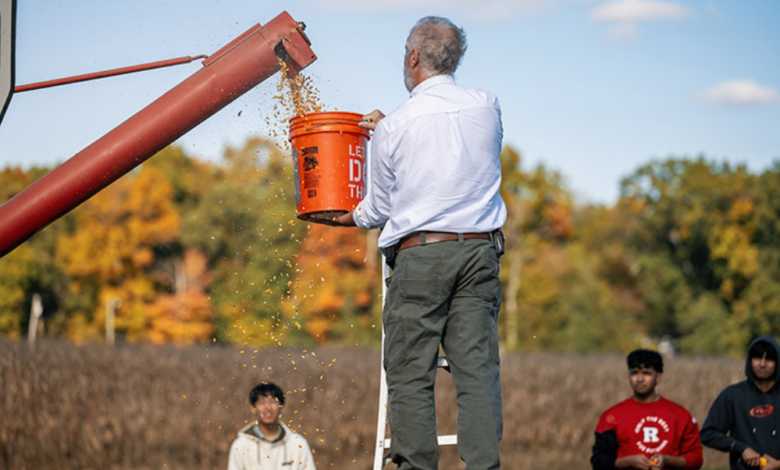
Rutgers students explore agricultural research, emerging farming technologies at South Jersey research center

BRIDGETON, N.J. (Cumberland County) — Rutgers University-New Brunswick students recently visited an agricultural research center in Cumberland County to learn how scientists are helping New Jersey farmers combat crop diseases, develop new technologies and keep their operations financially viable.
The visit to the Rutgers Agricultural Research and Extension Center in Bridgeton was part of a new interdisciplinary Honors College seminar, “Beyond Campus: Research at Rutgers Off-Campus Stations,” which takes students to 12 Rutgers research sites across six New Jersey counties.

The course, developed and taught by marine scientist Dave Bushek and plant pathologist Peter Oudemans, introduces students to research being conducted beyond the university’s main campuses and its connections to different academic disciplines.
During the visit, students explored plant diseases, artificial intelligence-assisted weed control, solar energy applications in agriculture and crop harvesting techniques.
Andy Wyenandt, a professor and extension specialist in vegetable pathology, showed students damaged bell peppers, basil leaves and dried asparagus stalks while explaining how researchers diagnose crop diseases.
“I run a mini-CSI lab for dead vegetables,” Wyenandt said.
Farmers, crop consultants and Rutgers Cooperative Extension personnel regularly bring damaged crops to the laboratory seeking diagnoses and recommendations for treatment.
“They want an answer as they’re walking out the door,” he said. “And 99% of the time, I can do that.”
One emerging concern involves Phomopsis stem blight, a fungal disease caused by Phomopsis asparagi that was detected in New Jersey asparagus crops in late summer 2025 and again in 2026.
The disease has forced some asparagus growers to increase fungicide applications from four to 16 times per season, adding significant costs to their operations.
“So, this one has us worried because growers haven’t traditionally had to control this disease,” Wyenandt said.
New Jersey has approximately 10,000 farms, which sold nearly $1.5 billion in agricultural products in 2022, according to the U.S. Department of Agriculture’s Census of Agriculture. Farmers in the state produce more than 100 vegetable crops and help supply fresh produce to a regional population of approximately 60 million people.
Joanna Paulraj, a 21-year-old senior biological sciences major from Pompton Plains, said the laboratory demonstrations connected with concepts she had studied in microbiology.
“I was really interested in seeing both the bell peppers and asparagus, and visualizing the impact of the pathogen,” Paulraj said.
Dan Ward, director of the Rutgers Agricultural Research and Extension Center, explained how the facility helps farmers improve efficiency and remain economically sustainable as agricultural land faces increasing pressure from other uses.
“The big challenge is how to continue into the next generation of farming,” said Ward, an associate research professor in the Department of Plant Biology at Rutgers’ School of Environmental and Biological Sciences.
Ward introduced students to agrivoltaics research, which examines how crops can be grown beneath and between solar panels while generating additional revenue from electricity production.
Researchers at the center are testing how tomatoes, bell peppers, eggplants and soybeans perform under different solar panel configurations.
The Bridgeton facility is one of three Rutgers farms participating in research for New Jersey’s dual-use solar pilot program. The findings are expected to help inform the state’s planned permanent agrivoltaics law and provide farmers with information when negotiating with solar developers.
“The farmer needs to come in prepared with knowledge so that they can negotiate something that’s co-optimized,” Ward said.
The research team is also developing model ordinances to help municipalities regulate agrivoltaics installations.
Bushek, a professor of marine and coastal sciences, said agricultural research connects with numerous fields beyond traditional farming.
“any aspect of farming is connected in so many different ways to so many different fields,” Bushek said.
The solar research, for example, involves engineering, economics, politics and electricity generation.
Students also learned how new technologies could change weed management.
Associate Professor Thierry Besançon demonstrated emerging equipment that uses artificial intelligence to identify weeds and precisely apply herbicides while avoiding crops. Other technologies use lasers or electricity to eliminate unwanted plants.
“That’s the way we’ll be managing weeds in the next 10 years,” Besançon said.
Veronica Girgis, a 20-year-old junior food science major from Branchburg Township, said she was particularly interested in the regulations governing pesticide and herbicide applications, which reminded her of federal food safety laws discussed in her coursework.
Anny Noh, a 20-year-old sophomore psychology major from Hillsborough, found similarities between plant pathology and human mental health studies.
“They also do diagnoses, they have different treatments, and they have stressors that might be causing the stress,” Noh said.
The students also visited a cornfield on the center’s 305-acre property, where they observed a combine harvesting dent corn, a variety that can be ground into cornmeal.
Students removed ears from corn stalks and collected kernels while Jesse Smith, a farmer at the research center, demonstrated how moisture levels are measured.
Ward said an initial moisture reading of 15.6% was ideal, although subsequent readings were higher, illustrating the variations researchers and farmers must account for when evaluating crops.
“There is a lot of variability to overcome,” Ward said.
The visit also included a look at an orchard where Rutgers researchers study diseases and insect pests affecting peach and apple trees.
Ward concluded the visit by encouraging students to share what they learn with others.
“The only way societies exist is with the passing of knowledge forward,” he said.