Rutgers study offers new evidence of increasing coastal erosion risk along Mid-Atlantic coast

NEW JERSEY — Storm conditions capable of causing major coastal erosion at North Beach on Sandy Hook are occurring about twice as often as they did in 1979, according to a new Rutgers University study that researchers say offers evidence of increasing erosion risk along the Mid-Atlantic coast.
The research, published in the journal Earth’s Future, found that storms capable of causing major erosion at the beach have become increasingly frequent since 1979. Researchers combined underground sediment imaging, water-level measurements, wave records and computer modeling to reconstruct more than 40 years of coastal storm impacts.
“Most people think of beaches as constantly changing landscapes where evidence of past storms quickly disappears,” said Kenneth Miller, a Board of Governors Professor in the Department of Earth and Planetary Sciences at the Rutgers School of Arts and Sciences and a co-author of the study. “What we’ve shown is that under the right conditions, beaches actually preserve a detailed geological memory of past storms. Those buried surfaces allow us to reconstruct how coastal storm impacts have changed through time.”

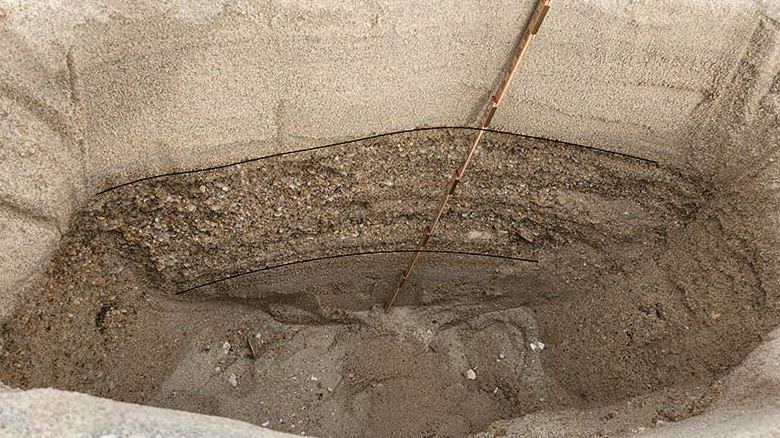
Researchers began studying North Beach in 2019 using ground-penetrating radar to image layers beneath the sand. They selected the site because it has naturally expanded into the Atlantic Ocean over the past two decades, preserving evidence of past erosion beneath newly deposited sand.
“Even initially, the data we collected were spectacular,” said W. John Schmelz, now an assistant research professor in Rutgers’ Department of Earth and Planetary Sciences. “The ground-penetrating radar clearly showed both the growth of the beach and the sedimentary structures left by erosion events that periodically interrupted that growth.”
The team identified 20 buried erosion surfaces created between 2009 and 2019 and confirmed they were associated with storms by comparing radar data with beach surveys and sediment samples.
Researchers then used computer simulations and historical tide and wave data dating back to 1979 to determine the conditions most likely to produce significant erosion.
“Our results suggest that storms capable of causing significant coastal erosion at this site are occurring about twice as frequently now as they did in 1979,” Schmelz said.
The researchers said the finding does not mean the overall number of storms has doubled. Instead, the combination of high water levels and large waves that produces major erosion now occurs about twice as often.
To test their findings, the team examined the effects of a Jan. 10, 2024, storm that exceeded the erosion threshold identified by their model. The storm lowered the beach by about 8 inches and pushed the shoreline inland by approximately 6 to 8 feet, leaving sediment patterns similar to those preserved from earlier storms.
“A long-term record of storm impacts is relatively rare,” Schmelz said. “Survey data are typically collected over too short of a period of time, or too infrequently, to resolve how temporary events like storms impact coastlines.”
Researchers said the approach could be applied to other expanding barrier beaches to better understand how climate and changing storm conditions are affecting erosion in coastal communities.
“The result is interesting from a climate perspective,” Schmelz said. “It is evidence that changes in climate are affecting the frequency of coastal erosion here in New Jersey.”