Historical marker unveiled for Revolutionary War route through Morris County

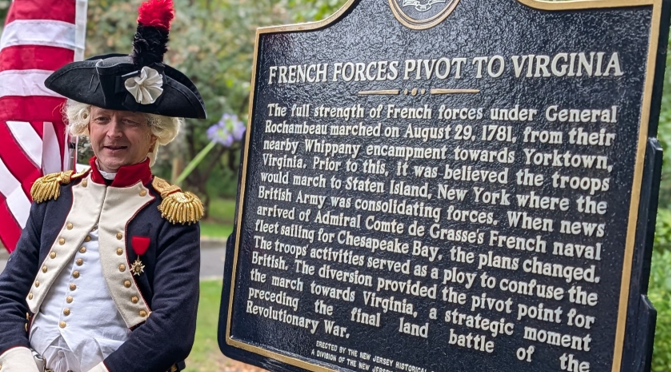
MORRIS TOWNSHIP, N.J. (Morris County) — A new historical marker at the Frelinghuysen Arboretum in Morris Township commemorates a section of the route traveled by American and French forces through Morris County on their way to the final major land battle of the Revolutionary War.
The New Jersey Historical Commission marker, titled “French Forces Pivot to New Jersey,” commemorates Aug. 29, 1781, when French forces under Gen. Jean-Baptiste Donatien de Vimeur, Comte de Rochambeau, left an encampment near Whippany and headed south with American forces.
The Continental Army, led by Gen. George Washington, and its French allies took part in a 14-week campaign along what is now known as the Washington-Rochambeau Revolutionary Route National Historic Trail, traveling from Newport, Rhode Island, to Yorktown, Virginia.

French forces began marching from Rhode Island in June 1781 and joined American forces before heading south toward Yorktown in August.
The historic route stretched about 680 miles across nine states using a network of 18th-century roads. While portions of the original path have been lost to development, much of the route remains in the form of modern roads, parks and waterways.
The marker at the Morris County Park Commission’s Frelinghuysen Arboretum is the first to physically designate where the trail passed through Morris County.
“This historical marker reminds us of the brilliant military tactics that led to the United States’ victory in the final siege and land battle of Yorktown and of a major turning point in your country’s independence,” said Myriam Gil, Deputy Consul General of France in New York.
France formally entered the Revolutionary War in 1778 and ultimately sent approximately 12,000 soldiers and more than 32,000 naval personnel to support the American cause. About 5,000 French soldiers and officers under Rochambeau passed through and encamped in the Morris County area in August 1781.
British forces had expected the French troops to move toward Staten Island, but the forces instead divided into three columns and marched south through New Jersey. Their route took them through Whippany, Pompton Plains and the grounds of what is now the Frelinghuysen Arboretum before they continued toward Virginia.
“The Revolutionary War was not only about the battles. Most of the time was about the time in between, which was very long and arduous and very scary,” said Morris County Commissioner Christine Myers, reflecting on military movements through Morris County that depended on local roads, communities and people along the route.
The Washington-Rochambeau Revolutionary Route National Historic Trail passes through more than 200 municipalities, including eight communities in Morris County.
“You hear the state referred to as the Crossroads of the Revolution, and it is true when you look at it,” said Sen. Anthony Bucco, a member of the New Jersey Historical Commission. “Our country’s independence was centered much of the time right here in Morris County.”
The marker is one of 42 being installed across New Jersey by the New Jersey Historical Commission as part of a series commemorating the nation’s 250th anniversary. The Morris Township marker is the third installed in the series.
“These markers are that physical reminder of the past,” said Sara Cureton, executive director of the New Jersey Historical Commission.
Congress designated the Washington-Rochambeau Revolutionary Route as a national historic trail in 2009. It is part of the National Trails System under the National Park Service, although the federal government does not own the land along the historic route.
“The fact that this is part of the National Park Service is a testament to the importance of this story to winning America’s independence as a nation,” said Brad Fay, executive director of the National Washington-Rochambeau Revolutionary Route Association, an organization dedicated to educating the public of the significance of the trail.
The Frelinghuysen Arboretum, originally known as Whippany Farm, encompasses 127 acres. Matilda Frelinghuysen donated the first 50 acres to the Morris County Park Commission in 1964 and bequeathed the remaining 77 acres in 1969. The property was dedicated as an arboretum in 1971 in memory of her parents, George Griswold and Sarah Linen Ballantine Frelinghuysen.
The property also has a connection to France through its architecture. Its Colonial Revival mansion, completed in 1892, was designed by Boston architectural firm Rotch and Tilden, whose architects were products of France’s École des Beaux-Arts curriculum.
Representatives from the Morris County Board of County Commissioners, New Jersey Historical Commission, National Washington-Rochambeau Revolutionary Route Association, Washington-Rochambeau Trail Alliance, Morristown National Historical Park, Friends of the Frelinghuysen Arboretum and The Park Alliance attended the unveiling.
The marker comes as the nation commemorates the 250th anniversary of the signing of the Declaration of Independence.
“We are deeply grateful to have contributed to the birth of your republic, and just as importantly, for the alliance and friendship that began after that,” Gil said.