

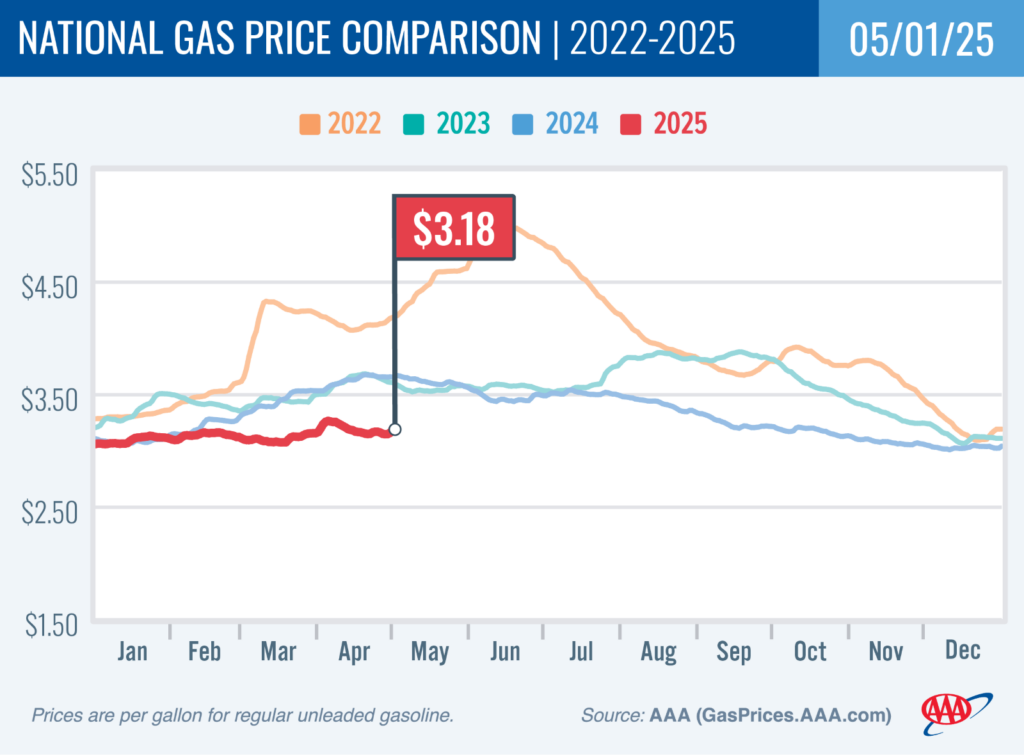
The national average for a gallon of regular gasoline saw little change over the past week, rising slightly to $3.18, according to AAA.
Although this is typically the time of year when seasonal increases and rising demand drive prices higher, the cost of crude oil has been declining. Several factors are contributing to this trend, including economic concerns and a decision by OPEC+ (a coalition of oil-producing countries) to increase output and add more oil to the market, despite muted global demand. Since crude oil prices heavily influence gasoline prices, a drop in oil means lower costs at the pump for drivers.
According to AAA, the current national average is nearly 50 cents lower than it was at this time last year.
Gas Price Snapshot:
- Today’s National Average: $3.186
- One Week Ago: $3.171
- One Month Ago: $3.201
- One Year Ago: $3.662
According to new data from the Energy Information Administration (EIA), gasoline demand decreased from 9.41 b/d last week to 9.09. Total domestic gasoline supply decreased from 229.5 million barrels to 225.5. Gasoline production decreased last week, averaging 9.5 million barrels per day.
At the close of Wednesday’s formal trading session, WTI fell $2.21 to settle at $58.21 a barrel. The EIA reports that crude oil inventories decreased by 2.7 million barrels from the previous week. At 440.4 million barrels, U.S. crude oil inventories are about 6% below the five-year average for this time of year.
EV Charging
The national average per kilowatt hour of electricity at a public EV charging station stayed the same this past week at 34 cents.
State Stats
Gas
The nation’s top 10 most expensive gasoline markets are California ($4.77), Hawaii ($4.50), Washington ($4.26), Oregon ($3.90), Nevada ($3.84), Alaska ($3.62), Illinois ($3.40), Pennsylvania ($3.35), Idaho ($3.31), and Utah ($3.31).
The nation’s top 10 least expensive gasoline markets are Mississippi ($2.66), Louisiana ($2.73), Tennessee ($2.74), Alabama ($2.76), Texas ($2.76), Arkansas ($2.78), Oklahoma ($2.80), South Carolina ($2.82), Kansas ($2.85), and Missouri ($2.85).
Electric
The nation’s top 10 most expensive states for public charging per kilowatt hour are Hawaii (55 cents), Alaska (47 cents), West Virginia (47 cents), Montana (44 cents), South Carolina (43 cents), Louisiana (43 cents), Tennessee (43 cents), Kentucky (42 cents), Idaho (42 cents), and Georgia (40 cents).
The nation’s top 10 least expensive states for public charging per kilowatt hour are Kansas (22 cents), Missouri (25 cents), Iowa (27 cents), Delaware (27 cents), Nebraska (29 cents), Utah (29 cents), Texas (30 cents), Maryland (30 cents), Vermont (30 cents), and North Carolina (31 cents).


