NEW JERSEY — Nearly four in 10 New Jersey residents surveyed by Hunger Free America reported that the food they purchased did not last and they did not have enough money to buy more, highlighting food hardship amid rising living costs and cuts to federal nutrition assistance.
The nonprofit organization released the findings of its new survey of 232 New Jersey adults at the First Presbyterian Church Food Pantry in Metuchen.

The survey found that 38% of respondents experienced difficulty affording enough food over the past year, with 13% reporting that it happened often. Additionally, 38% said they could not always afford balanced meals, 29% said they ate less than they felt they should because they lacked money for food, and 24% reported going hungry without eating because they could not afford food.
The findings were similar to those of a broader Hunger Free America survey of 2,400 U.S. residents across all 50 states, the organization said.
Before the Trump administration discontinued the annual federal food insecurity survey, the U.S. Department of Agriculture found that 9.7% of New Jersey residents lived in food-insecure households between 2022 and 2024.
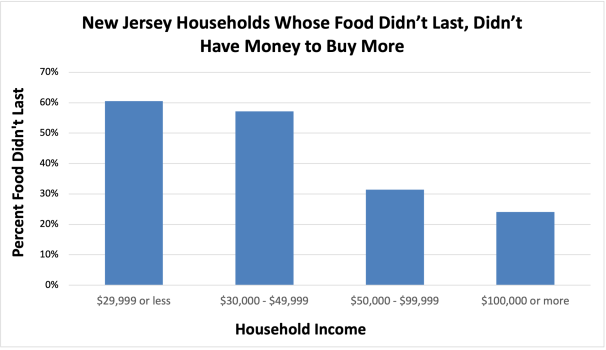
The new survey also found that food hardship extended to middle-income and higher-income households. Among New Jersey households reporting annual incomes between $75,000 and $150,000, 36% said the food they purchased did not last and they lacked money to buy more. Among households earning $150,000 or more annually, 16% reported experiencing the same hardship.
Across all income levels, 77% of respondents reported increases in food prices and other living costs over the past year, with 37% saying prices had increased greatly.
“Today’s U.S. and New Jersey hunger crisis is the most tangible embodiment of the nation’s affordability crisis, with even those previously thought to be solidly middle class suffering mightily,” said Joel Berg, CEO of Hunger Free America, a nationwide, nonpartisan nonprofit direct service and advocacy organization.
“The Trump administration’s ostrich approach to this issue — burying its head in the sand and refusing to even measure how its policies are increasing hunger — is failing, big time. While our own study is less comprehensive than the previous USDA studies, our report does provide concrete evidence as to why it’s so vital for the U.S. government to formally measure food insecurity on an annual basis, since previous USDA studies provided official hunger benchmarks that enabled government leaders, nonprofit groups, and philanthropies to obtain the data needed to understand how to best address the problem. The USDA must go back to not only measuring hunger, but also, even more importantly, go back to combatting hunger instead of fueling it.”
Families with children face food hardship
The survey found that 44% of New Jersey households with children younger than 18 sometimes or often ran out of food and did not have enough money to purchase more.
In comparison, Hunger Free America’s analysis of previous USDA data found that 12.9% of New Jersey children lived in food-insecure households between 2022 and 2024.
Among families with children surveyed, 23% reported having to purchase less nutritious food for their children, 19% reduced portion sizes, 6% said their children had to skip some meals and 2% reported being unable to feed all their children.
“The worst part of all this is that the nation’s U.S. hunger crisis was caused by absolutely unnecessary federal policy failures, which have both increased food prices and other vital costs of living while slashing nutrition assistance. These actions were both immoral and economically counterproductive. While the State of New Jersey has undertaken bold, proactive steps to address hunger — and should double down on that work — the State can’t pick up all of the burden if federal policies are fundamentally failing. That’s why we call on the lame duck session of Congress to rapidly reverse all the cuts in the Supplemental Nutrition Assistance Program (SNAP, formerly called the Food Stamp program), including extra costs for states, as well as to take concrete steps to slow inflation, make basic costs of living affordable for struggling families, and implement new programs to boost-long term economic opportunity for all,” Berg said.
Food pantries face growing demand
The survey found that 22% of respondents received food from a food pantry, soup kitchen, free meal program, food bank or religious institution at least once.
Some respondents who relied on those programs reported encountering wait times exceeding an hour, food shortages and difficulties obtaining food that met their dietary or cultural needs.
“Here at the FPC Food Pantry, we have seen an unprecedented 16% increase in registration over the past year. To meet the need, we rely heavily on our generous local community, food rescue efforts, and our county officials, including Replenish, our county food bank, and for that we are eternally grateful! However, the federal government has to step up and meet the need with us. We will not be able to sustain these increases without their help,” said Sarah Teti, director of missions for the First Presbyterian Church of Metuchen/FPC Food Pantry.
About one-third of New Jersey respondents said rising costs for gasoline, housing, health care, utilities, prescription medications or child care prevented them from affording the amount or quality of food their families needed.
“Every extra dollar that families have to spend to fill their gas tanks means one less dollar they have to fill their grocery carts,” Berg said.
Additional survey findings
Other findings from the New Jersey survey included:
- Twenty percent of respondents ages 65 and older reported that the food they purchased did not last and they lacked money to buy more.
- Forty-five percent said it had become harder over the past year to afford the amount and quality of food their households needed, compared with 13% who said it had become easier.
- Eighty-two percent said ensuring Americans have adequate food, housing and health care should be a higher federal government priority, compared with 9% who favored additional tax cuts for billionaires and corporations. Another 9% were unsure or declined to answer.
- Seventy-eight percent said they would be more likely to vote for a presidential candidate who proposed concrete plans to fight hunger, reduce poverty and expand economic opportunity. Eighteen percent said it would not influence their decision, while 4% said they would be less likely to support such a candidate.
The survey was designed by Kupersmit Research and conducted online from Oct. 9 to 16, 2026, using respondents drawn from the Dynata online panel, with sampling targets for ethnicity, age and gender. The organization reported a margin of error of 6.4 percentage points at a 95% confidence level.
“As we have seen in survey after survey, the American people want elected representatives to help them make ends meet. The sharp jump in the percent of Americans saying they are experiencing food insecurity in the past year represents a five-alarm fire for policymakers. We hope this data helps call attention to this crisis and urge policymakers to act now – while the economy is strong and unemployment is low – to help families afford the healthy food they need to thrive,” said Benjamin Kupersmit, president of Kupersmit Research.
“Both this study and the results of the midterm election make it crystal clear that the American people are suffering mightily from intertwined crises of widespread hunger, mass unaffordability, and evaporating economic opportunity. They will clearly reward those leaders who seriously address those concerns and remove from office those that don’t. I hope all our leaders take this wake-up call seriously,” Berg said.
The full study is available at hungerfreeamerica.org/en-us/research/2026-hunger-survey-reports.