

New toll rates approved by the Delaware River Joint Toll Bridge Commission will take effect at the start of the new year, with the updated rate structure beginning Jan. 1, 2026.
The bi-state commission, which operates bridges connecting New Jersey and Pennsylvania, said the toll schedule was approved by its board of commissioners in November. Officials said the increases are intended to help finance transportation infrastructure projects and improvements, offset rising construction costs and maintain favorable borrowing rates in the municipal bond market.
The rate changes apply to all vehicle categories and will be implemented across all eight toll bridges operated by the commission. Those bridges include Trenton-Morrisville on Route 1; Scudder Falls on Interstate 295; New Hope-Lambertville on Route 202; Interstate 78; Easton-Phillipsburg on Route 22; Portland-Columbia on Routes 611, 46 and 94; the Delaware Water Gap on Interstate 80; and Milford-Montague on Route 206.


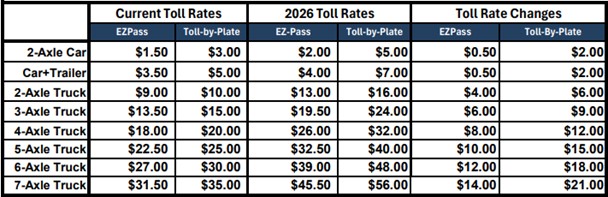
Commission officials said E-ZPass rates for passenger vehicles remain lower than tolls charged at other Delaware River crossings and comparable regional facilities. E-ZPass is used in nearly 87% of personal-vehicle transactions on commission bridges. E-ZPass rates for non-passenger vehicles are also lower than or competitive with those charged by other toll agencies, according to the commission.
The Delaware River Joint Toll Bridge Commission operates eight toll bridges and 12 toll-supported bridges that do not generate toll revenue. Those crossings connect Pennsylvania and New Jersey along the freshwater portion of the Delaware River, from the Philadelphia–Bucks County boundary north to the New Jersey–New York state line. The agency also maintains 79 lane miles of roadway surface, 39 short-distance approach bridges and other operational facilities.
All commission toll bridges operate under a cashless, all-electronic tolling system using E-ZPass and TOLL BY PLATE, with tolls collected only in the Pennsylvania-bound direction. TOLL BY PLATE customers are charged higher rates because of the additional costs associated with identifying vehicle owners and mailing toll bills.
The commission is funded solely through toll revenue and does not receive state or federal subsidies. Under identical statutes enacted by New Jersey and Pennsylvania and approved by Congress, the agency is required to use a portion of its toll revenue to operate and maintain 10 older vehicular bridges and two pedestrian-only crossings along the river, known as toll-supported bridges.


