NEW JERSEY — Rutgers University researchers have developed a new way to analyze mosquito waste that could help scientists detect West Nile virus and other emerging health threats and potentially strengthen early warning systems for disease outbreaks.
The approach uses a device designed to collect tiny droplets of mosquito waste for genetic analysis, allowing researchers to search broadly for viruses, parasites and other organisms carried by mosquitoes.
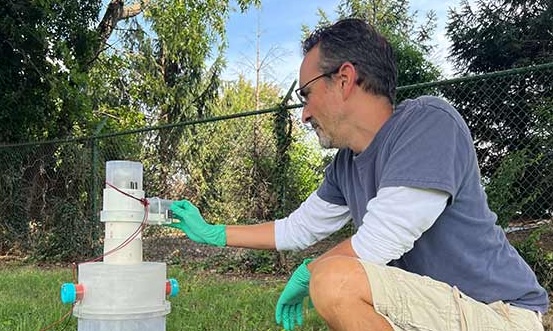
“What we did, colloquially, was build a mosquito toilet,” said Dana Price, an associate professor at the Center for Vector Biology in the Department of Entomology at Rutgers’ School of Environmental and Biological Sciences and a lead author of the study published in Microbiology Spectrum.

The device consists of a 3D-printed funnel coated with a water-repelling material that causes liquid to bead up and slide into a collection tube.
By sequencing genetic material found in mosquito waste, researchers recovered a complete West Nile virus genome, discovered what they said is the first known evidence of a Hedwig-like virus in the Americas and detected several viruses that could be new to science. Researchers also identified parasites and confirmed the species of mosquitoes that produced the waste.
“If you don’t look for it, you won’t find it,” Price said. “But what if you don’t know what to look for?”
Traditional mosquito surveillance generally requires collecting large numbers of mosquitoes, sorting them by species, combining them into groups and grinding them up for laboratory testing. The process can be labor-intensive and typically tests for specific pathogens researchers already know to look for.
Researchers theorized that viruses might be easier to detect in mosquito waste because it contains significantly less mosquito tissue and DNA than a crushed insect.
For the study, researchers collected two groups of 50 wild Culex mosquitoes from a New Brunswick yard in 2021 and 2022. Each group was placed in a screened container over the collection funnel and fed a sugar solution, allowing waste droplets to slide into a tube.
Researchers then used shotgun metagenomic sequencing, a technique that sequences all genetic material contained in a mixed sample.
The 2022 sample produced a complete, high-quality genome of West Nile virus. Researchers identified it as belonging to the NY07 genetic variant previously detected in the region.
“What came out was an entire viral genome,” Price said. “Rather than just positive or negative, we have genetic data.”
Researchers also detected evidence of a Hedwig-like virus, which Rutgers said had not previously been reported in the Americas. Hedwig virus was initially identified in snowy owl tissue in Europe and was named after the white owl in the Harry Potter series.
Scientists do not yet know whether Hedwig-like viruses cause illness in birds, play a role in West Nile infections or simply coexist with other viruses. Price said the discovery does not establish that the virus poses a threat but shows it was circulating in an area where researchers had not known to look for it.
“We didn’t even look for it specifically,” Price said. “We just looked for everything, and we found Hedwig in there.”
Price is working with the New Jersey Department of Environmental Protection’s Division of Fish and Wildlife to screen organ and tissue samples collected from deceased birds for the virus.
“The more data we generate, the more we start to wonder if everything is everywhere,” Price said. “Although we don’t yet know how much of everything is everywhere, it may be a lot more than we realize.”
Researchers also detected genetic sequences sufficiently different from known viruses to classify them as potentially new. They included a partiti-like virus, a picorna-like virus and a possible new virus associated with single-celled parasites that infect mosquitoes. Additional research is needed to determine whether they are previously unknown species.
Most of the viruses appear to infect mosquitoes, other insects or microorganisms living inside mosquitoes and are not known to cause disease in humans, according to Rutgers.
The mosquito waste also contained traces of trypanosomatids, a group of single-celled parasites known to infect mosquitoes. DNA analysis showed the insects primarily belonged to the Culex pipiens group, which can carry West Nile virus.
Price cautioned that the study was an initial demonstration and is not intended to replace existing mosquito surveillance. The research involved 100 mosquitoes collected from one location and transferred to the collection device in a laboratory.
Researchers also cannot determine from mosquito waste alone whether a mosquito is capable of transmitting a virus. The virus could be infecting the mosquito or another organism inside it, or could simply be passing through the insect.
The team is now working to develop a field-ready trap capable of collecting mosquitoes and their waste. Price said the eventual goal is a system that could prepare samples, sequence genetic material, remotely analyze results and alert scientists to potential threats in real time.
“The pie-in-the-sky idea is a device that we place in a forest somewhere, and it’s constantly just beaming back data to us,” Price said.
Other Rutgers researchers involved in the study include Mehdi Javanmard of the Department of Electrical and Computer Engineering; Taewon Han, an assistant research professor in the Department of Environmental Sciences; laboratory researcher Nicole Wagner; and former undergraduate students Miranda Barnes and Fiona Bezhani.