NEW JERSEY — Two early-career Rutgers University oceanographers will lead an international team of scientists on a 25-day research expedition in the Atlantic Ocean to study a little-understood ocean mixing process that may influence marine life, ocean chemistry and the movement of carbon through the sea.
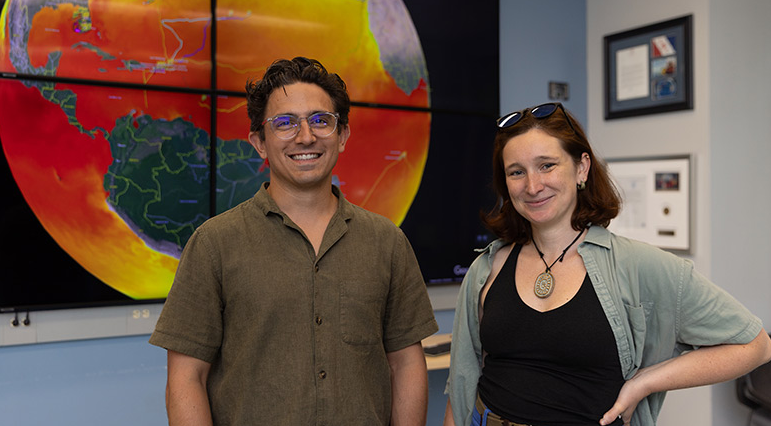
Joe Gradone and Corday Selden will depart Aug. 9 aboard the research vessel Falkor (too) from Bridgetown, Barbados, serving as co-chief scientists for a team of 19 researchers from around the world.
The expedition is supported by the Schmidt Ocean Institute, which provides selected researchers with access to its 363-foot research vessel, advanced technology and technical support through a competitive selection process.

Gradone, an assistant research professor, and Selden, an assistant professor in Rutgers University’s Department of Marine and Coastal Sciences, will oversee daily scientific operations while coordinating research focused on “salt finger mixing,” a process that occurs when layers of ocean water with different temperatures and salinity interact.
Researchers hope the findings will improve scientific understanding of how ocean circulation affects marine ecosystems and carbon storage.
“Schmidt Ocean Institute’s support gives Rutgers scientists and students access to extraordinary shipboard capabilities,” said Josh Kohut, dean of research at the Rutgers School of Environmental and Biological Sciences and director of research at the New Jersey Agricultural Experiment Station. “For Joe Gradone and Corday Selden, this expedition is both a major scientific opportunity and a defining career moment as they lead an international team studying processes that are difficult to observe but essential to understanding the ocean and its global reach.”
The team will collect biological, chemical and physical measurements at sampling stations across the Atlantic using ocean gliders, water sampling equipment and other scientific instruments. Some data will be analyzed aboard the ship, while other samples will return to Rutgers laboratories for further study.
“Do we capture the spectrum in salt finger mixing that we’re trying to capture?” Selden said, describing one of the expedition’s primary scientific goals.
“We’ll know that while we’re on the ship,” she said.
The research team will work around the clock during the expedition, with days beginning before dawn as scientists deploy equipment, collect water samples and monitor ocean conditions.
Gradone said adaptability is essential during ocean research.
“Problems, failures, issues, they’re all like the norm,” Gradone said.
“Things go wrong,” he said. “We’ll figure it out.”
Selden said one of the most rewarding aspects of ocean research is mentoring students during fieldwork.
“One of the most rewarding parts of shipboard science is watching students come fully into their responsibilities,” she said. “Everybody gets to own a part of the mission, and you can see their confidence grow as they come into their role.”
The Rutgers team includes Gradone, Selden, oceanographer Travis Miles, doctoral students and technical staff working alongside researchers specializing in physical oceanography, marine biology, chemistry and zooplankton ecology.
As the expedition approaches, Gradone reflected on the opportunity to lead the mission.
“It’s awe,” he said.
He described the experience as a mixture of “anxiety,” “responsibility” and “gratitude.”
Selden said the expedition marks an important milestone for both researchers as they establish their careers.
“This project is very important for both of us,” Selden said. “This is going to be a big component for both of us as we’re moving forward, establishing ourselves.”
The expedition is scheduled to conclude in early September.