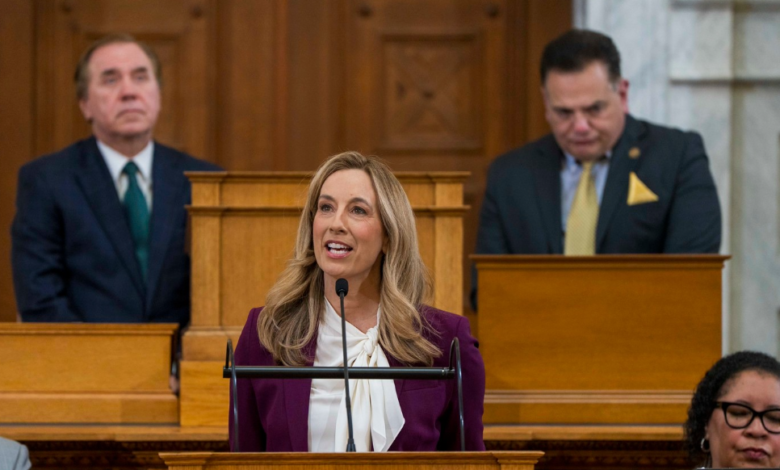
TRENTON, N.J. — Gov. Mikie Sherrill on Tuesday unveiled a $60.7 billion state budget proposal for fiscal year 2027, framing it as an “affordability budget” that aims to lower costs for middle-class families while maintaining fiscal discipline.
In her first budget address since taking office, Sherrill said the proposal prioritizes property tax relief, record investments in education and measures to reduce energy costs, while also attempting to curb long-term spending growth.
“This is an affordability budget, rooted in lowering costs for hardworking families and making state government more accountable to the people we serve,” Sherrill said in remarks delivered in Trenton.

The spending plan includes a projected $5.4 billion surplus and represents a 1.6% increase over the adjusted fiscal year 2026 appropriation. State officials say it reins in spending by nearly $2 billion compared with previous projections.
More than 74% of the proposed budget would be directed back to communities through property tax relief programs, social services, higher education funding and aid to schools, municipalities and counties.
The proposal includes $4.2 billion in property tax relief, including $2.3 billion for the ANCHOR program, $350 million for the Senior Freeze program and nearly $700 million for the Stay NJ property tax relief initiative.
Under the plan, eligibility for Stay NJ would be limited to households earning $250,000 or less and the maximum benefit would be capped at $4,000. The administration said the changes are intended to better target relief toward middle-income residents.
Sherrill’s budget also includes a $7.3 billion payment to the state pension system, marking the sixth consecutive full pension payment and the first time in decades a governor has fully funded the pension system in the first year of an administration.
State Treasurer Aaron Binder said the plan attempts to balance affordability and fiscal stability.
“This proposed budget is an important step toward implementing Governor Sherrill’s vision of a more affordable New Jersey while maintaining a strong commitment to fiscal discipline,” Binder said.
Education spending would reach record levels under the proposal. The budget includes $12.4 billion for K–12 schools — a $370 million increase from the previous year — and $1.4 billion for preschool education aid.
The plan also allocates $15 million for high-impact tutoring programs aimed at addressing pandemic-related learning gaps and expands school meal eligibility to an additional 21,000 children.
Healthcare spending remains a major component of the proposal, with $7.2 billion in state funding for NJ FamilyCare, the state’s Medicaid program that covers more than 1.8 million residents, including nearly half of New Jersey’s children.
The administration also proposed investments in energy affordability, including plans to freeze certain utility rate increases and provide additional assistance payments for lower-income residents through the Residential Energy Assistance Payments program.
The budget includes more than $1 billion in operating support for NJ Transit and roughly $2.1 billion for the state’s transportation capital program, including highway, bridge and transit projects.
Republican lawmakers criticized the proposal, arguing it continues a pattern of growing state spending.
Assembly Republican Conference Leader Christopher DePhillips said the budget “moves in the wrong direction.”
“Spending continues to move in the wrong direction — up and up, just like the last eight years,” DePhillips said. “Overall, this budget is not a win for the people of this state and does not improve affordability.”
Assembly Republican Budget Officer Brian Rumpf also criticized the proposal, saying revenue increases on businesses amount to new taxes.
“When we’re talking about the new spending in this budget, what we’re talking about is new taxes,” Rumpf said.
State Sen. Michael Dunn, a Republican, also questioned the administration’s claim that the plan makes meaningful spending reductions.
“New Jersey does not have a revenue problem; we have a spending problem,” Assemblywoman Aura Dunn said in a statement. “Continuing to increase spending while layering on new taxes only perpetuates the cycle of fiscal irresponsibility.”
Sherrill’s proposal now heads to the Legislature for review and negotiations before the fiscal year begins July 1. Lawmakers traditionally revise the spending plan before approving a final budget.