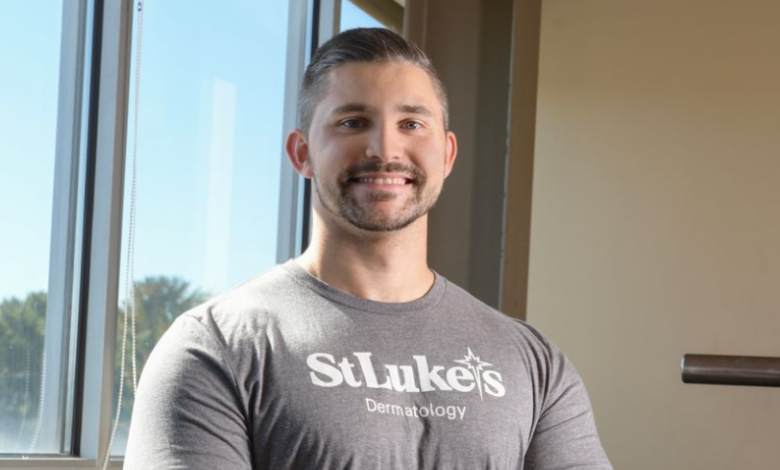
A St. Luke’s University Health Network dermatology resident is applying lessons learned from 14 years of competitive powerlifting to his medical career, emphasizing consistency, patience and knowing when to push forward or step back.
Dr. Vanden Grube, a 2024 graduate of Temple/St. Luke’s School of Medicine and current resident in St. Luke’s Dermatology Residency program, recently competed in his 16th powerlifting competition, achieving personal records while continuing his medical training.

During the competition, Grube recorded a 660-pound squat, 390-pound bench press and 730-pound deadlift, finishing with a combined total of 1,780 pounds. His performance included personal records in both the squat and overall total, achieved without injury.
Despite those accomplishments, Grube said the most valuable lesson from powerlifting has been the importance of maintaining consistency rather than simply lifting heavier weights.
“I have found it is not the act of lifting heavier weights over time, but rather remaining consistent that is the most difficult part of the sport to this day,” he said. “Consistency over the last 14 years has helped me develop a sense of forced accountability, a frequent opportunity to interrogate my own excuses and has provided me a greater capacity to handle the stress and challenges of everyday life.”
Grube began weightlifting as a high school freshman and entered his first powerlifting competition shortly before graduation. Over the years, he has developed a disciplined approach to training that emphasizes preparation, recovery and avoiding unnecessary risks.
Those same principles have helped guide him through medical school and into his dermatology residency.
When Grube began his medical education at Temple/St. Luke’s School of Medicine, he already knew he wanted to pursue dermatology and hoped to continue his training at St. Luke’s.
Now in residency, he said one of the most rewarding aspects of his medical career is working directly with patients while learning alongside fellow residents and faculty.
“Aside from the increased responsibility in residency, the biggest difference is the reward of spending my days with patients and learning side by side from my co-residents and faculty.”
Grube describes dermatologists as physicians who “wear many hats,” taking on responsibilities that can involve surgery, pathology, infectious diseases and immunology.
He has developed a particular interest in dermatologic surgery and values the range of clinical experiences available through St. Luke’s, including procedural training, outpatient clinics and inpatient consultations involving infectious, inflammatory and autoimmune diseases.
Another important lesson from residency, he said, has been learning to navigate uncertainty when diagnosing and treating patients.
“There will be times when you are not fully certain on a diagnosis for a patient, or there is a case that presents challenges with management in residency training and thereafter as a board-certified dermatologist,” he said.
Through clinical training, educational sessions and collaboration with colleagues and faculty, Grube has learned to approach complex medical cases systematically, much as he approaches challenges in powerlifting.
His most recent training cycle also reinforced the importance of recognizing personal limits and allowing time for recovery.
“This training cycle has really taught me when to hold back, which is more important than deciding when to approach and push limits,” he said.
Grube said his deliberate approach to balancing risks and rewards has helped him avoid significant injuries throughout his powerlifting career. When problems arise, he prioritizes recovery rather than pushing through potential injuries.
Looking ahead, Grube hopes to combine his clinical skills with patient education and mentorship as he continues his career in dermatology.
“I hope to fulfill a role that is not only centered on diagnosis and treatment of dermatologic disease but to also serve as a compassionate educator who patients trust,” he said, “along with being an approachable attending in whom those in training can seek mentorship.”