Rutgers research farm in Hunterdon County helps local farmers improve crops, test new technology

PITTSTOWN, N.J. (Hunterdon County) — A 390-acre Rutgers University research farm in Hunterdon County is helping local farmers improve crop production, test new agricultural technology and adopt sustainable farming practices while providing students with hands-on research opportunities.
The Clifford E. and Melda C. Snyder Research and Extension Farm in Pittstown serves as an outdoor laboratory where researchers study crop diseases, pest management, agricultural technology and environmentally sustainable farming methods.
Established in 1988, the farm is operated by the New Jersey Agricultural Experiment Station and provides research and educational outreach to farmers in Hunterdon County and surrounding communities.

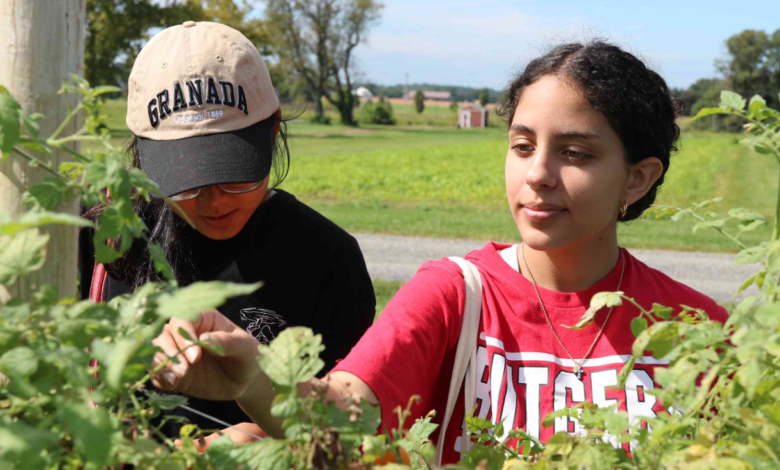
Recently, 10 Rutgers University-New Brunswick Honors College students visited the facility as part of an interdisciplinary seminar called “Beyond Campus: Research at Rutgers Off-Campus Stations.”
The course takes students to Rutgers research facilities throughout New Jersey on Friday field trips, allowing them to observe scientific research outside traditional classrooms.
During the visit in September, Snyder Farm Director Peter Nitzsche explained the facility’s history and its mission of helping farmers address agricultural challenges.
Nitzsche, who also serves as extension department head for Rutgers Cooperative Extension of Morris County, said the farm continues the work of Clifford and Melda Snyder, who supported agricultural innovation and shared their farming practices with others.
“They conducted innovative practices, tried new technologies and then invited other farmers to view those technologies,” he said. “They wanted to set up an experiment station here. They’d seen other Rutgers facilities … and we’ve carried on their tradition.
“What we do is demonstrate, improve practices and test technologies. Does it help the farmer? Does it make them more money? Does it make them more economical? Does it preserve the environment? We test those things at the farm, and we invite farmers out to look at the plots on a regular basis. Hopefully, it helps improve their production practices.”
Students toured the property aboard a tractor-pulled wagon, observing research involving peaches, apples, tomatoes, pumpkins and other specialty crops.
Nitzsche discussed integrated pest management, an approach that combines different techniques to control agricultural pests while limiting unnecessary environmental impacts.
“That is using all the tools in your arsenal in order to keep pests at an economic or an acceptable level,” he told the class. “So, you try to do everything you can, the most benign, easiest method, cheapest method. But if you can take advantage of a resistant variety, a variety that’s been bred that doesn’t get a disease, we plant that first. We encourage growers to plant that. If there are biologicals, if there’s a predator that we can release into the plot to control the pest, we do that.”
One of the projects students observed involves agrivoltaics, which combines agricultural production with solar energy generation on the same land.
At Snyder Farm, researchers are growing hay between rows of solar panels that automatically track the sun. The project examines whether the presence of solar panels affects crop growth and yields.
“We’re looking at yield,” Nitzsche told the students. “We’re growing the hay between the panels and then outside the panels. Does the hay grow the same amount? Faster? Slower? Lower yields?
“So far, we haven’t seen big yield differences. So, that’s a good thing.”
The farm also supports research involving drones, precision agricultural equipment and autonomous weeders, technologies that could help farmers reduce costs, improve efficiency and protect the environment.
“Some of that work involves new technology such as drones, precision agricultural equipment and autonomous weeders,” he noted. “The farm will continue to help support the work to test and demonstrate this new agricultural technology to see it helps local farms remain sustainable economically while also protecting the environment.”
For students, the visit provided an opportunity to see how scientific research applies to agriculture and other fields.
Kyle Yoon, 19, a sophomore mechanical engineering major, was among the students who picked a quart of Rutgers-developed “Scarlet Sunrise” grape tomatoes during the tour.
“This is my lunch,” Yoon told Rutgers professor Dave Bushek, who accompanied the students.
Yoon said the experience offered a different perspective on university research.
“This is kind of a different opportunity compared to being in a lecture hall or something, being able to go out to different places around Jersey – and just learning more about research and what it’s like, because I also wanted to get into the field of research,” said Yoon, who was born in Los Angeles before moving to Closter, N.J.
Yoon also observed that mechanical engineering applications could be found throughout the farm’s research projects.
Jen Kim, 19, a sophomore landscape architecture major from Forked River, said she was surprised by the variety of research taking place at the facility.
“I didn’t know that there were so many projects ongoing here,” said Kim. “It seems like if you’re a researcher or an investigator who has a project that you want to investigate, you are able to have the space to do that, which I thought was really interesting. I just think it’s neat to learn about the different resources that are available to us as students at Rutgers.”
Veronica Girgis, 20, a junior food science major from Branchburg, said the visit helped her better understand the connection between agriculture, technology and food production.
“I’m glad that I get to see where everything comes from,” said Girgis. “I have a greater appreciation for everything that we eat. It all comes from the land and from the research at these centers.”
Bushek, a professor of marine and coastal sciences at Rutgers, said visiting research facilities helps students understand concepts that can be difficult to fully appreciate in a classroom.
He said growers “can come and read about the technology and the innovations that we develop, but until they actually see it, they don’t have confidence that it’s something that they can use. And in the same sort of way, students can read about and learn it, but they don’t quite make the connections until they can get their hands on it and actually touch and feel and taste what’s happening and understand those differences and what it actually means in a much more real sense.”
Nitzsche said the farm’s research and outreach programs ultimately aim to strengthen New Jersey agriculture while protecting natural resources.
“We’re doing a lot of work to help local farmers stay in business and to help them produce healthy food that also is caring for the environment and protecting the environment,” Nitzsche said. “The tax money is going for good and helping us support the local community.”