CAPE MAY COUNTY, N.J. — The U.S. Department of Agriculture’s Animal and Plant Health Inspection Service has confirmed the presence of the invasive box tree moth at private residences in Cape May County, prompting a quarantine on the movement of boxwood plants and related materials from the county.
The New Jersey Department of Agriculture announced that the quarantine prohibits the movement of live boxwood plants, debris or dead boxwood material outside Cape May County without a fully executed compliance agreement authorized by the department.
The box tree moth is a federally regulated invasive pest that feeds primarily on boxwood plants. If left untreated, the insect can severely damage or kill the popular ornamental evergreen shrubs.

According to the USDA National Agricultural Statistics Service, New Jersey’s nursery and landscape industries that rely on boxwood plants generate more than $9.8 million in annual economic activity, while the national industry is valued at an estimated $140 million.
State officials said the discovery was not unexpected because infestations have already been confirmed in neighboring Delaware, Pennsylvania, Maryland and New York, as well as in Michigan, Ohio and Massachusetts.
Only a handful of properties in Cape May County have confirmed infestations, and control measures have already been implemented. The New Jersey Department of Agriculture is working with USDA officials and Rutgers Agricultural Experiment Station Cooperative Extension to map the extent of the infestation.
The invasive moth is capable of spreading naturally between three and six miles per year, although experts believe it may travel as far as 20 miles. Officials warned that the caterpillar stage is particularly destructive and can completely defoliate a boxwood plant in as little as 10 days.
The caterpillars are lime green with black stripes, white spots, hair and shiny black heads. After consuming leaves, they feed on the bark, which can kill the plant. Heavy infestations also produce extensive webbing.
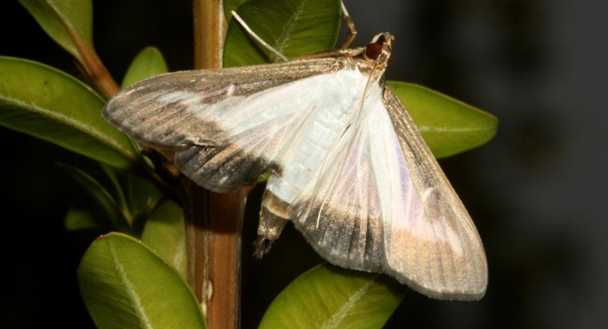
Adult box tree moths typically have white wings with thick brown borders and are most active at night.
The New Jersey Department of Agriculture is urging homeowners with boxwood shrubs to inspect their plants for brown or skeletonized leaves, defoliation, webbing and caterpillars.
Residents who suspect an infestation should contact the New Jersey Department of Agriculture or the Rutgers Cooperative Extension office in Cape May County to report the pest and learn about treatment options. State and federal agricultural officials may also inspect plants and place detection traps.
Officials recommend removing infested branches, or cutting heavily infested plants to the base to encourage regrowth. All boxwood debris should be double-bagged and disposed of in the trash.
Nursery owners, landscapers and plant dealers are also encouraged to monitor boxwood inventory, implement safeguards to reduce the risk of spread and report any detections to the New Jersey Department of Agriculture.
Additional information and management recommendations are available at https://www.nj.gov/agriculture/divisions/pi/prog/BoxtreeMoth.shtml.