
The Delaware River Joint Toll Bridge Commission is marking the 90th anniversary of congressional approval for its formation, a milestone that paved the way for expanded cross-state travel and infrastructure between New Jersey and Pennsylvania.
Congress gave consent to the compact creating the commission on Aug. 30, 1935, under the U.S. Constitution’s Compact Clause. The action followed agreements signed in December 1934 by New Jersey Gov. A. Harry Moore and Pennsylvania Gov. Gifford Pinchot.
The commission formally organized on Dec. 28, 1934, in Philadelphia, taking over from a predecessor body that had worked to eliminate private toll bridges along the river. The new agency was authorized to issue bonds for bridge construction and collect tolls to repay debts and fund operations.

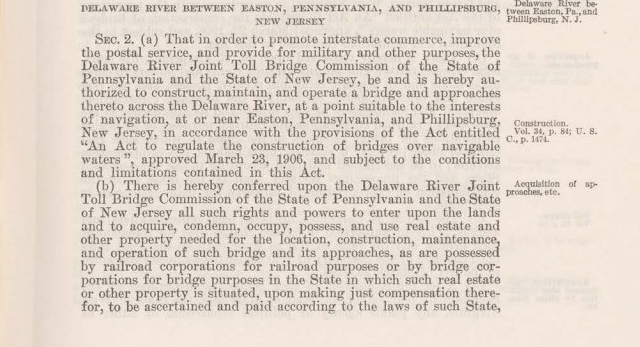
Its initial priority was building a modern bridge between Easton, Pa., and Phillipsburg, N.J., to relieve congestion at the Northampton Street Bridge. That effort led to the Easton-Phillipsburg Toll Bridge, which opened in January 1938 and remains one of the commission’s busiest crossings.
Over the decades, the commission constructed additional toll bridges, including those at Trenton-Morrisville, Portland-Columbia, Delaware Water Gap, Milford-Montague, and New Hope-Lambertville. It also took on responsibility for 12 non-toll bridges, known as “toll-supported bridges,” using toll revenue to cover their upkeep.
Today, the commission operates both toll and non-toll spans, including the cashless all-electronic Scudder Falls (I-295) Toll Bridge, and is working on converting its older tolling facilities to similar highway-speed electronic systems.
The commission continues to oversee nearly three dozen Delaware River crossings as it begins its 90th year of operations.


