Rutgers physicist uses AI collaboration to advance research, calls for shift in scientific training

NEW JERSEY — A Rutgers University physicist has developed a new artificial intelligence-assisted method to simplify complex particle physics equations, while highlighting the growing role of AI in scientific research and education.
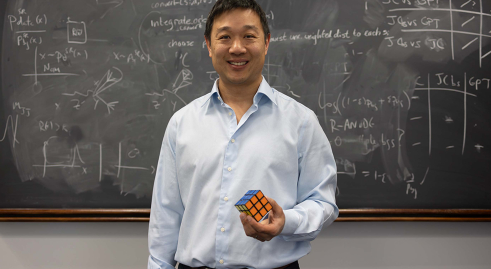
David Shih, a professor in the Department of Physics and Astronomy at Rutgers, said inspiration for the method came from an unexpected source — solving Rubik’s Cubes with his children.
“In reaching our solutions, we found that an analogy between mathematical simplification and solving Rubik’s Cubes was key,” said Shih. “Both can be viewed as scrambling and unscrambling problems.”

The research, posted to the scientific preprint site arXiv, introduces a machine learning approach that can simplify complicated equations used in particle physics, where calculations often involve hundreds of terms.
Shih said the method achieved strong results.
“Our new method achieved a nearly perfect simplification rate, far surpassing previous machine learning-based methods,” he said.
The project also explored a different dimension of research — Shih conducted the work in collaboration with an artificial intelligence system known as Claude, which assisted with coding, data analysis and drafting the research paper.
“This research is also noteworthy for how it was carried out in full collaboration with Claude Code, an agentic AI system that did all of the hands-on work under my supervision,” said Shih.
He described the AI’s role as similar to that of a graduate student.
“Claude is actually functioning here like a graduate student would,” he said. “It did all the hands-on labor that a student would normally be doing in one of my projects.”
Other researchers said the work reflects broader changes underway in scientific research.
“This new style of research which is done in collaboration with AI agents has the potential to massively accelerate our research,” said Jack Hughes, chair of Rutgers’ Department of Physics and Astronomy. “There is an urgent need to train our students and postdocs in this new style of research.”
Shih said working with AI allowed him to take on more complex problems.
“If we learn how to use these tools properly, it will allow us to take on more ambitious problems,” he said. “It changes the scale of what one person can do.”
The research also raises questions about the future of scientific discovery and the role of artificial intelligence.
“Can they reach total autonomy, or will they just remain a tool that will make us all much, much more powerful?” Shih said. “I think that’s the trillion-dollar question right now.”
While some experts speculate AI could eventually operate independently in research, Shih said a more likely outcome is a collaborative model.
“There are some people who are saying that we’re going to get 10,000 Einsteins, that humans are going to be obsolete and just going to be sort of watching the AIs do research,” he said. “I don’t know if that’s going to happen. I think what is much more likely is that it’s going to allow scientists to do much more than they can today.”
Shih said universities may need to adapt by training students to work alongside AI systems, emphasizing skills such as guiding and validating AI-generated work.
“The key skill for the next generation of scientists will not just be solving problems, but learning how to work with AI, guide it and validate what it produces,” he said. “If we do that well, the payoff could be enormous in terms of faster progress and new discoveries.”