
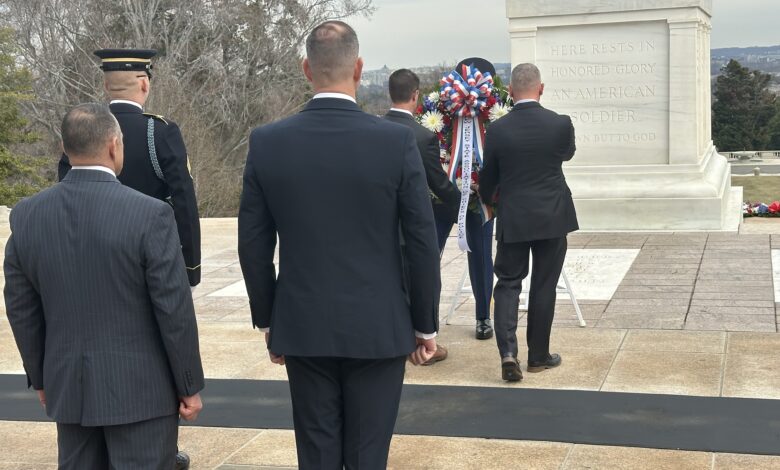
WASHINGTON – Board Members of the New Jersey State Association of Chiefs of Police (NJSACOP) made a special visit to the Tomb of the Unknown Soldier at Arlington National Ceremony on Feb. 25, laying a wreath to remember and honor those unidentified service members who made the ultimate sacrifice.
Under the close direction of the U.S. Army’s 3rd U.S. Infantry Regiment, known as “The Old Guard,” NJSACOP members quietly descended the stairs of the Memorial Amphitheater at the symbolic grave and offered the floral tribute, symbolizing the beauty and brevity of life.
“We were honored to be here to pay our formal respects to America’s unidentified heroes,” said NJSACOP President John Russo, chief of the Rutherford Police Department. “This is a sacred place of mourning overlooking the U.S. Capitol in the distance. It was an incredible experience to be at this site with my fellow police chiefs, reflecting on the enormous sacrifices connected to military service, valor and, sometimes, loss.”

The wreath included a white banner that read “New Jersey State Association of Chiefs of Police.” It was placed temporarily at the tomb, a white marble sarcophagus that has been a symbol of sacrifice and service at the cemetery since 1921.
Four of the 10 NJSACOP delegates took part in the laying of the wreath: Russo, NJSACOP First Vice President and Montville Police Chief Andrew Caggiano, NJSACOP Second Vice President and Collingswood Police Chief Kevin Carey and NJSACOP Third Vice President and Elizabeth Police Chief Giacomo Sacca.
Following the ceremony, the NJSACOP members were invited into the Old Guard quarters underneath the Memorial Amphitheater, where they met with Staff Sgt. William Matyas, an impeccably uniformed member of the Old Guard who led the wreath-laying event. The 35-year-old career soldier was eager to answer questions, pose for photos and explain the disciplined life of a sentinel.
Sgt. Matyas explained how the Tomb Guards work on a three-relief rotation; each relief has one commander and about six Sentinels. The three reliefs are organized by height, so that those in each guard change ceremony look similar in appearance. The Sentinels wear the Army dress blue uniform, reminiscent of the color and style worn by soldiers during the late 1800s.
Every day, Tomb Guards march exactly 21 steps down the black mat behind the Tomb, turn, face east for 21 seconds, turn and faces north for 21 seconds, then take 21 steps down the mat and repeats the process. (The number 21 symbolizes the highest military honor that can be bestowed, the 21-gun salute.)
Next, the Sentinel executes a sharp “shoulder-arms” movement to place the weapon on the shoulder closest to the visitors, signifying that he or she stands between the Tomb and any possible threat.
The Sentinels stand watch 24 hours a day, 365 days a year, in any weather. Sentinels, who volunteer for this post, are considered the elite of the elite 3rd U.S. Infantry Regiment, the oldest active-duty infantry unit in the Army, serving the United States since 1784.


