Gas prices across the United States edged higher this week following a major winter storm that disrupted fuel production and increased demand ahead of severe weather, according to AAA.
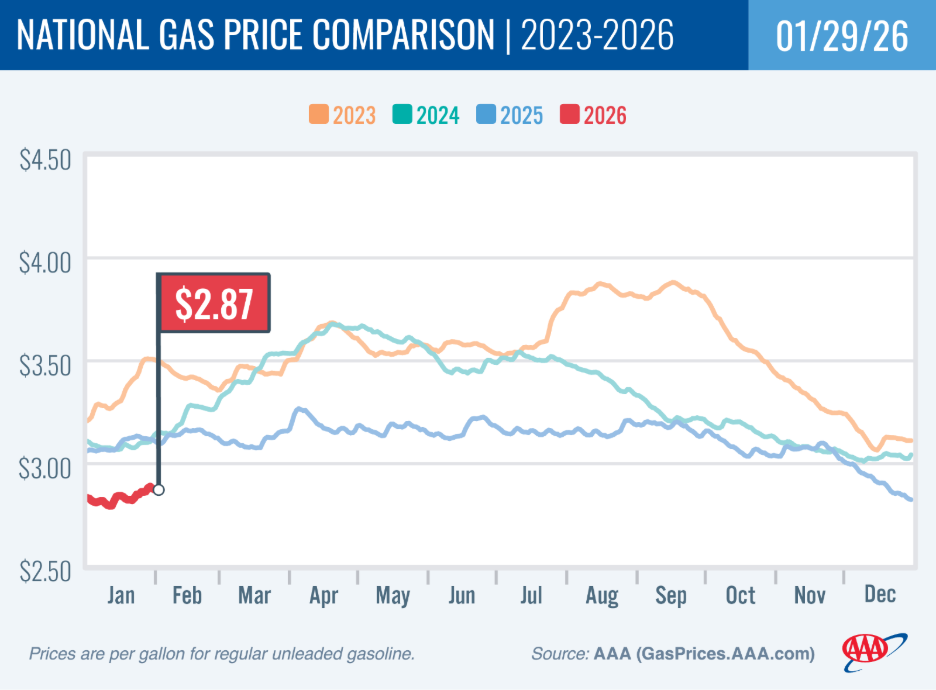
AAA said the national average price for a gallon of regular gasoline rose to $2.87 as of Thursday, up slightly from $2.85 a week ago. The increase follows widespread below-freezing temperatures and lingering snow that disrupted some crude oil production and refinery operations, while motorists filled their tanks in advance of the storm. Despite the uptick, prices remain well below last year’s national average of $3.12 at this time.

According to data from the U.S. Energy Information Administration, gasoline demand rose sharply last week, climbing from 7.83 million barrels per day to 8.75 million. Domestic gasoline supply also increased slightly, from 257 million barrels to 257.2 million barrels, while gasoline production averaged 9.6 million barrels per day.
In oil markets, West Texas Intermediate crude rose 82 cents on Wednesday to settle at $63.21 a barrel. The EIA reported that U.S. crude oil inventories fell by 2.3 million barrels last week and now stand at 423.8 million barrels, about 3% below the five-year average for this time of year.
AAA said electric vehicle charging costs remained stable, with the national average price at public charging stations holding at 38 cents per kilowatt hour.
Gasoline prices continue to vary widely by state. Hawaii topped the list of the most expensive markets at $4.41 per gallon, followed by California at $4.26 and Washington at $3.88. Oklahoma reported the lowest average price at $2.40, followed by Arkansas at $2.43 and Mississippi at $2.44.
Public EV charging costs also varied across the country. West Virginia had the highest average rate at 51 cents per kilowatt hour, while Kansas reported the lowest average at 25 cents.
AAA encourages drivers to monitor fuel and charging prices along their routes using its TripTik Travel planner as winter weather and market conditions continue to influence costs at the pump.