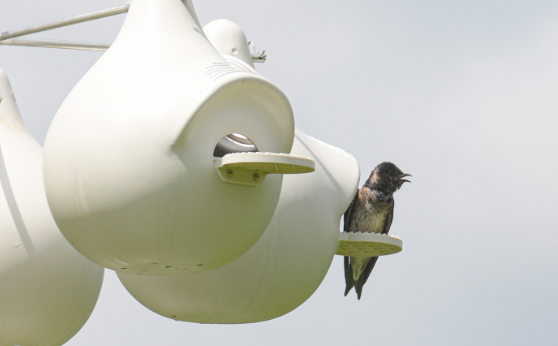
BETHLEHEM TOWNSHIP, Pa. (Northampton County) – Purple martins have returned to nest at St. Luke’s Anderson Campus for a second consecutive year, signaling the establishment of a new colony at the hospital’s expansive Bethlehem Township property.
The migratory birds, which travel north each year from as far away as the Amazon rainforest, have taken up residence in man-made nesting structures installed near a pond on the Anderson Campus.
Their return marks a conservation success for St. Luke’s Director of Landscape Services Tom Fiorini, who spearheaded efforts to attract the birds to the campus.

Purple martins once were common throughout the Lehigh Valley but declined as farming practices changed and fewer man-made nesting sites were available. East of the Mississippi River, the species relies entirely on human-provided nesting structures.
Two winters ago, Fiorini installed a tall pole fitted with gourd-shaped bird houses in an arboretum near one of the campus ponds. The structures remained empty for months before several purple martins moved in during June 2025.
The birds successfully nested and raised chicks last year, and their return this spring suggests the colony is becoming established.
Photographs of the birds were reviewed by experts from the Cornell Lab of Ornithology and Muhlenberg College’s Acopian Center for Ornithology, both of which confirmed the species identification.
“To have first year success, means you have a very good location,” said Peter Saenger of Muhlenberg College’s Acopian Center for Ornithology, who noted that east of the Mississippi River, Purple Martins are 100% dependent on man-made nests. “So, what you have done there is phenomenally important.”
“Every colony is important since Purple Martins in the east are 100% dependent upon these man-made nesting sites. Groups in the area, along with those at Anderson, are helping to establish a significant population of these beautiful and utilitarian birds in the Lehigh Valley area.”
The largest of the New World swallows, purple martins feed primarily on flying insects and are known for their agile aerial maneuvers. They often nest near permanent water sources and thrive in areas with abundant insect populations.
The 500-acre Anderson Campus includes ponds, farmland, sunflower fields and proximity to the Lehigh River, creating favorable habitat for the birds.
Fiorini said one of the most rewarding aspects of the project is knowing the birds are likely to return year after year.
“The coolest thing,” he said, “is that they are going to know this spot, and they’ll keep coming back year after year.”