
Sussex County partnership transforms Native American artifact collection into research resource

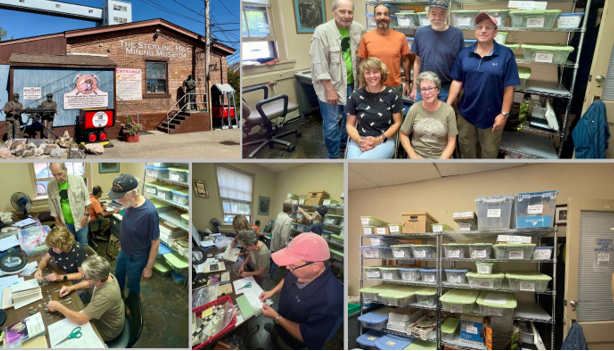
SUSSEX COUNTY, N.J. — A collaboration between the Sterling Hill Mining Museum, Sussex County Community College and a team of archaeologists and students is reshaping how Native American history in the region is preserved and understood.
The initiative is converting a private collection of artifacts into a documented archaeological resource aimed at education and research, providing new insight into the area’s earliest inhabitants.
“When I first saw the collection at the Mine, it was beautiful, but there was no archaeological or cultural context,” said Everett Conklin, a teacher and avocational archaeologist. “There was no timeline to help the public understand what they were looking at. I realized quickly that this was much larger than a simple identification project.”

The effort began in 2024 when Conklin was asked to review a collection of arrowheads and stone tools. What started as a small cataloging project quickly expanded into a multidisciplinary collaboration involving archaeologists, former professors and students.
“What we thought would start with a couple of milk crates turned into a full working lab,” Conklin said. “We’ve been identifying projectile points, labeling sites, and confirming decades of careful documentation.”
The artifacts were originally collected over more than 30 years in the Wallkill Valley by brothers Bill and Bruce Bihn, who documented their findings without disturbing archaeological sites.
“They kept meticulous logbooks and documented everything,” Conklin explained. “Our work confirms what they recorded and creates a more accurate, modern labeling system that aligns with the original sites.”
Project leaders said the goal is to redesign the museum’s display to emphasize historical context over quantity.
“Instead of displaying 335 artifacts, we want to curate about 70 pieces that represent specific time periods and cultural developments,” Conklin said. “We want visitors to see the continuous flow of mining and tool-making activity in this area and understand the cultural significance of the projectile points. Our goal is to create a meaningful, well-organized research collection that is thoroughly documented and accessible for both students and the community.”
Students at Sussex County Community College are playing a key role in the project, gaining hands-on experience in artifact preservation and analysis.
“Students working here are getting a masterclass in archaeology,” Conklin said. “They’re learning how to preserve artifacts, store them properly, analyze materials, and tell the story behind them.”
The project also incorporates modern technology, including X-ray fluorescence testing to trace the origins of stone tools.
“The curation at Sterling Hill will be enhanced by using the XRF (X-ray Fluorescence) Spectrometer in the new SCCC Archaeology Laboratory,” said Dr. Tony Balzano, professor of anthropology. “The XRF will provide a geochemical signature for a stone artifact that can be traced back to registered Sussex County archaeological sites. Once we have a sense of the origins of artifacts, we can begin to reconstruct the cultural patterns of life before Europeans arrived here. With an understanding of the ethnography of Munsee-speaking peoples, such as their Ramapough Lunaape descendants, we can begin to reconstruct the cultural lives of Munsee peoples before Europeans arrived.”
Researchers say the findings are helping to fill gaps in the region’s archaeological record.
“The shape determines how old the artifact is,” said archaeologist Bill Sandy. “On archaeological sites, when points are found in association with datable materials, we can determine their age. That’s how we know, for example, that the bow and arrow didn’t arrive in New Jersey until around 500 AD.”
“One of the most exciting findings is related to the earliest people in the New Jersey portion of the Wallkill Valley,” Sandy said. “There are no known fluted spear points dating back 12,500 years in this area except in the Bihn Collection, where we have at least three. The Bihn brothers surface-collected some of the most significant archaeological sites in New Jersey.”
“People celebrate 250 years of American history, but we’re missing a vast majority of the story,” Sandy added. “The Wallkill River National Wildlife Refuge is one of the most exciting places to conduct archaeology based on discoveries from the last decade. The river flows north between two major south-flowing rivers, the Hudson and the Delaware, making it a critical resource for early settlement.”
Students involved in the project said the experience has reshaped their academic paths.
“I’ve learned so much about geological formations and stone materials,” said student Karen Nelson. “I came back to school out of curiosity, and now I plan to continue taking classes at SCCC.”
“After taking Dr. Balzano’s archaeology course, I fell in love with the program,” said graduate Kalee McCloud. “Being involved in this project made me realize how important it is to understand the past. It completely changed my perspective.”
“I’m incredibly fortunate to work with this group,” said Tony Lombardo, a former student now pursuing graduate studies. “This experience has been foundational for my specialization in archaeology.”
Organizers said the project aims to honor both the Native communities who created the artifacts and those who preserved them for future study.
“These were sophisticated, intelligent, resourceful people,” Conklin said. “Our responsibility is to tell their story accurately and make sure it’s never lost again.”


